VF/IF Tires: When They Make Sense - And When They Don't
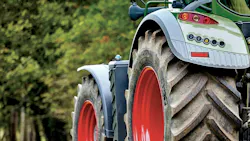
"VF represents an evolution of IF (improved flexion) technology," says Dave Paulk, manager, field technical services, for BKT USA Inc. "It stands for 'very-high flexion' and it is a standard introduced by the TRA (Tire & Rim Association.)
"Among the main advantages of VF tires over IF ones is the fact that VF tires allow farm machinery to carry heavier loads with reduced inflation pressure. A tire using VF technology is designed to carry 40% more weight at the same air pressure as a standard tire, while IF tires are designed to carry 20% more weight than standard tires at the same air pressure."
According to Paulk, lower inflation pressure "makes VF tires good for the soil, as a larger tire footprint translates into reduced soil compaction. Therefore, using VF tires can help make farming more sustainable and environmentally friendly.
"Another main difference is speed ratings, as most of the VF and IF tires have a D speed rating (40 mph), with some of them featuring the E rating (45 mph)."
When does it make sense and not make sense to recommend IF and VF tires? "Each farmer's specific needs, applications and working conditions differ," says Paulk. "The choice of the most appropriate tire will be unique, as there is no universal solution that suits all farmers and their activities.
"IF and VF tires are recommended when farmers deal with heavy loads, sensitive soils or equipment that regularly transitions between field work and road transport. In fact, operating at lower air pressures, IF and VF tires can minimize ground pressure and soil compaction, thus enhancing crop growth and increasing yields. Also, IF/VF tires can be used when more weight-carrying capacity is needed and standard tires are not rated for the load and/or speed. They also help operators who don’t want to constantly adjust tire pressures throughout the day, because IF and VF casings tolerate load variation better than standard radials.
"On the other hand, recommending IF or VF tires doesn’t make much sense when the equipment is light, the loads are modest or the customer’s operation doesn’t push the limits of standard radial tires.
"BKT’s IF tires, such as AGRIMAX FORCE, AGRIMAX TERIS, AGRIMAX RT 600, to mention some of them, are designed for large, powerful machines working in demanding field conditions. This makes them ideal for modern and high-efficiency farming operations, involving tillage, heavy draft wor, and large implements. By using IF technology, BKT emphasizes that farmers can maintain lower pressures, improve the tire’s footprint and reduce soil stress while still supporting the machine’s weight.
"Since VF tires can carry 40% more weight at higher speeds than standard tires and 20% more than IF tires, they are the right choice when a machine must carry significantly higher loads at lower inflation pressures, especially in situations where soil protection, traction efficiency and operational flexibility are critical. Specifically, BKT’s AGRIMAX V-FLECTO is the company’s solution to the demands of high‑power tractors operating in both soil tillage and transport, where reduced soil compaction and strong self‑cleaning are essential.
"So VF tires are the best choice when a farmer needs maximum load capacity and minimal soil compaction, particularly on high-horsepower tractors and combines working in demanding field and transport conditions."