How to Spot and Fix Out-of-Round Conditions
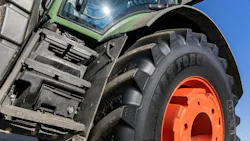
Out-of-round tires can cause vibrations and uneven tread wear. How can you identify and address out-of-round conditions?
"With the technology now used, many tires are more uniformly made than in days past," says Dave Paulk, manager, field technical services, BKT USA Inc. "There are some things to check when vibrations occur that don’t necessarily have anything to do with the tire."
Tires and wheels are not perfectly round, says Paulk. "Each has a high spot and a low spot. If the high spot on a wheel is matched to the high spot on a tire - or the low spot to the low spot - this can cause vibration. The high spot of one needs to be matched to the low spot of the other. Match mounting the tire to the wheel generally ensures the best ride possible.
"If a tire is not properly seated on the rim, this can cause radial or lateral vibration. The tire bead should be properly seated on the rim all the way around to eliminate lateral runout and swaying back and forth.
"Low-horsepower tractors (less than 100 HP) have a shorter wheelbase and can cause some vibration in the driver’s seat, generally starting at about 20 mph," says Paulk. "This can be caused by the wheel not being centered on the hub. Adjustable rims are common on smaller tractors. While these rims are great for adjusting the wheelbase width, they are bad for wheel runout, which can cause vibration."
Paulk lists several ways to address and mitigate out-of-round conditions, noting that "the production process plays a relevant role in limiting tire runout. Correct handling and positioning of the different tire components, together with advanced and precise tread winding processes, can minimize tire runout.
"Matching the tire and rim, with high and low spots, can minimize runout in a tire and wheel assembly and reduce vibration.
"Air pressures can be adjusted to ensure a good ride and minimal vibration based on the vehicle’s weight and the amount of weight carried. Over-inflation can play a big part in excess vibration at higher speeds.
"Unless the tire is out-of-round from the start due to manufacturing, application can affect how the tire rides and rolls. Oftentimes, the heavier the equipment - such as combines and large tractors - the longer the wheelbase, and the slower the speed, the less vibration will be felt. The faster and lighter the machine, the more likely vibration will be felt at certain speeds.
"Equipment is available to check for runout on tires and determine whether the runout exceeds the manufacturer’s recommendation," he explains. "Radial and lateral runout can be checked. Radial runout is the amount of up-and-down movement a tire shows. This is the most common cause of a problem and can cause vibration in the steering or the driver’s seat. The distance should be close to the same when measuring from the center of the wheel to the outside of the tread around the tire. Lateral runout is side-to-side motion and is sometimes caused by not properly seating the tire on the rim.
If the user feels the vibration is uncomfortable, there are a few steps they can take to try to solve the problem, according to Paulk:
1. Make sure the tire bead is properly seated on the rim. "If it isn’t, this can cause both excessive radial and lateral runout and the tire will feel out of round."
2. On smaller horsepower tractors (usually 100 HP and less), make sure the wheel is centered on the hub. "If the wheel is not centered, this can create a lope that feels like an out-of-round tire."
3. If there is a slight vibration in the tire, match mounting it to the wheel can sometimes solve this by matching the low spot of the tire to the high spot on the rim or vice versa. Turning the tire 90 degrees on the rim can sometimes help minimize the vibration if match mounting is the cause, says Paulk.
4. Make sure air pressures are correct for the weight. "Over-inflating a tire can cause many issues, but one issue it can cause is vibration at certain speeds."
"No tire and wheel assembly is perfectly round, so there is always a bit of runout. This should be minimized for the best tire and wheel performance. BKT has a tight tolerance for runout and uniformity to minimize vibration problems caused only by tires. Match mounting tires to wheels and ensuring they are mounted properly solves many problems."