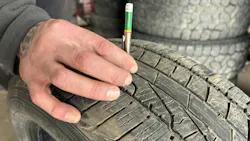
To replace a passenger tire at 2/32-inch or 4/32-inch? That’s a million-dollar question in the retail tire world — an age-old debate that has left industry experts and tire companies with conflicting opinions about at what measurement passenger tires should be replaced.
The federal government has set the legal minimum tread depth for passenger tires at 2/32-inch, the point where grip, handling and wet stopping distance are believed to become severely compromised.
While the National Highway Traffic Safety Administration (NHTSA) issues Federal Motor Vehicle Safety Standards such as this, states have the authority to enforce tire removal at their own levels.
Some states, such as California and Idaho, have set their legal minimum tread depth at 1/32-inch. Most states still follow the federal standard of 2/32-inch and at least six states don’t have an official limit.
The last time MTD took a deep dive into tread depth standards was 18 years ago, when it published a story outlining existing data and what tire manufacturers’ stances were on the issue.
At the time, industry experts argued there was not a major difference between 2/32-inch and 4/32-inch on dry road surfaces. But a test conducted by Tire Rack that gained attention showed that a passenger car tire traveling at 70 mph with 4/32-inch tread depth had a much quicker stopping distance on a wet asphalt track than a vehicle with 2/32-inch tire tread traveling at the same speed.
After these findings, Tire Rack started recommending that passenger tires be replaced at the 4/32-inch mark. However, while the company also favored that consumers test tread depth with a quarter rather than the traditional “Lincoln penny” test, Matt Edmonds, then-vice president of Tire Rack, said the decision of when to replace was ultimately the driver’s choice.
The story also noted that companies like Michelin North America Inc., the first tire manufacturer to take a stance on this issue, were opposed to raising tread wear indicators to 4/32nds due to the lack of evidence around low tread depth leading to more vehicle accidents. Back then, NHTSA’s Fatal Accident Reporting System found that tires were a factor in 1.1% of all light-vehicle fatal crashes.
Other companies, such as Continental Tire North America (now known as Continental Tire the Americas LLC) and Goodyear Tire & Rubber Co., recognized 2/32-inch as the minimum standard tread depth, while Bridgestone Americas Inc. said at the time that it was “still studying the issue of tread depth.”
So after all these years, what has changed?
In the past year, organizations such as the Safe Tread Alliance (STA), formed by Alex Bebiak, founder of the Road Ready Foundation, and Jamie Ward, CEO of Cincinnati, Ohio-based tire dealership Tire Discounters Inc., began calling for tire safety standards to be modernized and for “outdated tread depth check practices” to be eliminated.
Bebiak, whose son was killed in a 2023 car accident caused by excessively worn tires, says the RRF has a mission of “educating young and experienced drivers on tire safety and roadside safety education.”
As a coalition of industry leaders, safety advocates, groups like the Ohio Tire and Automotive Association and Tire Discounters, STA is calling for the elimination of the old consumer “penny test” tread depth rule of 2/32-inch, which they call an unsafe practice, and is instead advocating for the “quarter test” to be adopted. (When a quarter is placed into the tire’s tread with George Washington’s head down, if the top of his head is visible, the tread depth is at or below 4/32 of an inch — the point where performance and wet-weather safety start significantly declining.)
STA also urges tire manufacturers and other organizations to adopt the 4/32-inch minimum tread depth standard and for the United States government to join 57 other countries of the United Nations Economic Commission for Europe in passing a regulation enforcing strict tests to ensure tires maintain a certain level of performance and wet grip.
Keeping this in mind, what are tire companies’ current policies on minimum tread depth standards and why? How should tire dealers communicate their depth policies to customers?
TIA’s perspective
The Tire Industry Association (TIA) follows federal safety standards from the U.S. government, including NHTSA and the Department of Transportation, when issuing guidance and training for industry organizations.
When it comes to tread depth recommendations, TIA follows the federal guidelines of a minimum 2/32-inch tread depth policy for passenger and light truck tires, according to Kevin Rohlwing, chief technical officer, TIA.
Since the government still abides by this standard, Rohlwing says TIA isn’t getting involved in the so-called “2/32nds versus 4/32nds debate,” but he says the discourse mostly centers around two key factors: wet stopping distance and location.
Multiple studies, such as Tire Rack’s test outlined in MTD’s 2008 article, show a tire with 4/32-inch tread requires less stopping distance than a tire with 2/32-inch tread. While acknowledging this fact, Rohlwing says that doesn’t mean a 4/32-inch tread depth is safer. It all comes down to the consumer’s needs, preferences and their location, he says.
“You have to be conscious of the consumer’s needs,” says Rohlwing. “Educating the consumer is one thing, but trying to suggest a tire is not safe at 3/32nds or 4/32nds when the federal government has set 2/32nds as the number ... I think that becomes a slippery slope.”
Once a tire reaches below the legal limit of a 2/32-inch tread depth, the wear can extend to the body and can severely impact traction and handling, according to Rohlwing. During precipitation, there are even more risks and stopping and maneuverability can also be negatively affected.
“The measurable safety difference between 2/32nd and 1/32nd on wet pavement is significant enough that the federal government says 2/32nd is the limit,” he says.
The UTQG (Uniform Tire Quality Grading) of a tire adds another important element to the conversation, according to Rohlwing.
Because a tire’s traction rating becomes a factor in a vehicle’s stopping ability, especially on wet pavement, Rohlwing says that factor should be considered when determining when to replace a passenger tire.
“When we’re getting into the wet stopping ability discussion, I think the traction rating plays another role in this. Tread depth is a factor, but traction rating is another factor, because now you’re talking about compounding, tread designs and the engineering of the tire itself.”
Overall, Rohlwing says when deciding when to remove and replace passenger tires, tire dealers must communicate their policy and inform their customers about what is best for their circumstances.
“To me, it’s all about the dealer educating the consumer and giving them the information they need to make the best decision for their climate or their driving style. Where do they drive? How do they drive? Is it highway versus city driving?”
Tiremakers’ policies
Following a range of federal and state regulations, tire manufacturers must ensure their products are produced safely and consistently to deliver reliable quality to customers.
While some tiremakers have followed the U.S. government and the Department of Transportation’s guidelines of recommending replacing passenger tires at 2/32nds for decades, others recommend replacing tires sooner or encourage drivers to consult a local dealership first.
MTD asked several tire manufacturers if they have a specific policy about tread depth removal and how tire wear can impact performance.
Wes Boling, senior manager of communications and content, Nokian Tyres, says his company “recommends replacing tires when they reach a tread depth of 4/32 of an inch. Tires with tread wear below that mark have deteriorating grip, especially in wet conditions. For winter tires, we recommend 5/32-inch.”
“Hankook Tire America Corp. follows the U.S. Tire Manufacturers Association guideline that once a tire tread wears down to 2/32nds of an inch anywhere across the tread face, it should be replaced,” says Daniel Brown, technical services unit manager, Hankook.
Goodyear Tire & Rubber Co. notes that maintaining proper tread depth “is critical for ensuring tire performance, safety and reliability. Goodyear follows industry standards and considers tires to be legally worn out at 2/32-inch," officials say. "Tires must be replaced at that point to maintain compliance and prevent traction loss. Goodyear also recommends monitoring tread depth once it reaches 4/32-inch, as wet traction and braking decline.”
Matthew Thomas, manager of consumer applications, Bridgestone Americas Inc., says that Bridgestone “complies with state and federal regulations, which state that drivers must replace their tires when the tread depth reaches 2/32 of an inch.”
Tire dealers “provide the best advice on when it's appropriate to replace tires at the consumer level, due to their knowledge and understanding of the driver, tires and local driving conditions. It’s important to note that Bridgestone’s limited mileage warranty references the federal limit of 2/32nds for a tire to be considered ‘worn out.’ However, we recognize the importance of maintaining performance, so we allow consumers to submit a limited mileage warranty claim as high as 4/32nds.”
Performance concerns
Nokian’s Boling says that “low tread depth leads to poor grip and handling, since a tire’s grooves and sipes are the key to channeling precipitation away from the road surface. The deeper the tread, the more moisture the tire can remove from the road. The shallower the tread, the bigger the risk of hydroplaning or sliding.
“At 4/32nds, some key performance characteristics start to decline. In some instances, lateral grooves hold less water, which reduces the tire's ability to evacuate water,” says Robert Nasca, product training manager, Hankook Tire America Corp.
“At 2/32nds, the sipes, any remaining tread and the contact patch are severely reduced, allowing for hydroplaning and poor wet braking. In short, 4/32-inch marks a meaningful loss in wet performance, while 2/32-inch marks the end of safe service life for passenger tires.”
Bridgestone’s Thomas says “a tire’s grip potential is derived primarily from its compound. However, the tread pattern governs the tire's capacity to evacuate water from the road and expel it from the tread. A helpful way to visualize this is to think of tread grooves as water pipes. As the tread wears, those pipes get smaller, making it harder to push water away.
“While tires near 4/32 of an inch may experience some degree of hydroplaning, depending on the tire, at 2/32 of an inch, it becomes almost inevitable that a tire will hydroplane on substantially wet roads.
“For winter performance, the compound determines how flexible the pattern remains in cold weather, while features like sipes and edges determine how much snow a tire can ‘grab,’” he explains. “This is crucial because snow-to-snow interaction — compacting snow against snow — is largely what provides grip.
“To use pipes as an analogy again, picture a winter tire’s tread as a long pipe that’s easy to bend. As a tire wears down, the pipe becomes shorter, thus becoming more difficult to bend. At 4/32nds, the biting edges in a tire’s tread pattern begin to stiffen and lose their ability to grab the snow. By 2/32nds, most of those pattern features are completely gone, making it nearly impossible for the tire to gain traction in winter conditions.”
Tire dealerships weigh in
When it comes to tread depth policies, many major tire dealerships establish their own recommendations within industry criteria.
Discount Tire, one of the three largest independent tire dealerships in the U.S. with over 1,200 locations, according to last year’s MTD 100, recommends replacing passenger tires at 4/32-inch and below.
Citing NHTSA’s 2012 study, “Tire-Related Factors in Pre-Crash Phase,” which shows the correlation between low tread depth and the increased likelihood of being involved in an accident, Discount Tire recognizes that stopping distance increases as a tire wears, which can especially become dangerous in wet, snowy and extreme weather conditions.
“Performance decreases significantly once tread depth drops to 4/32”,” the dealership’s website points out. “Tires this worn are unsuitable for wet or snowy conditions.”
Monro Inc., the second-largest tire dealership in the U.S., says there is a difference between “legal” tires and tires that perform well, especially on wet pavement. The company recommends consumers start shopping for new tires when the tread reaches 4/32-inch.
Monro also says the quarter test adds an extra safety barrier when checking tread depth compared to the penny test and waiting until the legal limit to replace.
“With bald tires, you might not be able to stop in time to avoid an accident,” according to the dealership’s website. “Your vehicle is also more likely to hydroplane on bald tires.”
As the largest independent tire dealership in the U.S., according to the 2025 MTD 100, Mavis Tire Express Services Corp., which has over 3,500 locations and operates under several names, follows government recommendations that say a passenger tire has a “usable tread depth” until it reaches less than 2/32-inch.
According to its website, Mavis recognizes both the quarter and penny tests and states that 4/32nds is a sign your tires are close to needing replaced, while the tread depth of 2/32nds shows an immediate need for new tires.
What comes next
While it doesn’t seem that there are major moves within the U.S. government to broadly change the legal minimum tread depth, some states with heavy precipitation, winter weather patterns and harsher road conditions are more frequently continuing to review their specific laws.
Tire manufacturers whom MTD contacted say they don’t foresee a significant push to a higher minimum standard, but they are seeing stronger relationships building between dealers and customers that prioritize safety and education.
“I do see the industry changing how manufacturers communicate and educate their dealers,” says Nasca. “Rather than changing the legal limit, I see the focus is shifting toward better consumer education, improved testing and stronger messaging around real-world safety.”
Thomas also doesn’t see the industry changing to a higher minimum tread depth, but he says data shows that drivers aren’t looking at regulations when deciding when to replace their tires. Instead, they are relying on the guidance of tire dealers.
“Federal or state regulations are not the primary determinant of when consumers replace their tires,” says Thomas. “It’s their local tire dealer. Data shows that on average, consumers are already replacing their tires well before the legal limit. This indicates that drivers, guided by the expertise of their tire professionals, are already prioritizing performance based on their individual needs rather than waiting for a regulatory floor.”
Sidebar #1: How to communicate tread depth safety standards
MTD asked tire manufacturers, “Do you have any advice for how dealers should communicate passenger tire technology and safety standards about tread depth to customers?” Here’s what they said:
“Many tire shops display sample tires with low, medium and high tread depths,” said Wes Boling, senior manager of communications and content, Nokian Tyres. “This, along with informational language, provides an interactive way for customers to understand the importance of changing their tires at the right time.”
According to Robert Nasca, product training manager, Hankook Tire America Corp., “Dealers should keep the conversation simple, visual and safety-focused. I recommend measuring the tread depth in front of the customer, showing the gauge reading and explaining what the number means for wet and winter performance. Incorporate real driving situations like stopping distance, rain and light snow rather than a sales pitch.”
“Regarding how to communicate this to customers, the best approach is to move beyond general rules of thumb and focus on a personalized dialogue,” says Matthew Thomas, manager of consumer applications, Bridgestone Americas Inc. “We encourage dealers to tap into their relationship with the customer to understand their specific concerns, experiences and driving environment. By combining the technical knowledge from our training materials with an understanding of what the consumer is actually feeling on the road, dealers can provide the most effective advocacy for a customer's performance needs.”
About the Author
 Aden Graves
Aden Graves
Associate editor
Aden Graves is MTD's associate editor. A graduate of Kent State (Ohio) University's award-winning School of Media and Journalism, Graves holds a bachelor's degree in journalism and another bachelor's degree in communication studies.