Ben Tire Celebrates 100 Years of Growth
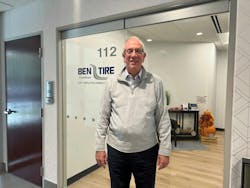
With a century of service that spans six warehouses, 25 retail stores and about 300 employees, the story of Ben Tire Distributors Ltd. began on a much smaller scale, with a single service station in Toledo, Ill.
Edgar Neal opened that service station as Neal Oil Co. in 1925 and grew it into a medium-sized petroleum distributorship in central Illinois. In 1943, Neal Oil became a B.F. Goodrich tire distributor.
Two years later, Edgar Neal’s son, Burnham E. Neal, returned home after completing his military service. The younger Neal took over operations at the service station and was eager to expand its tire business.
In 1959, the Neals opened a warehouse in Tuscola, Ill., and began to sell Dayton tires. A year later, a tire dealer in Mattoon, Ill. sold his business to the Neals. This became the first Neal Tire & Auto retail store.
In the decades since, both the wholesale and retail arms of the operation have grown and expanded with locations in three states: its original home turf in Illinois, plus Kentucky and Indiana.
Burnham E. Neal used his own initials to rename the corporate entity Ben Tire. The company's retail stores continue to operate under the Neal Tire name.
After 100 years in business, Ben Tire has withstood plenty of challenges. Jim La Neve is Ben Tire’s fourth CEO and he says in 2025, the company is well-positioned for the future. These are “exciting times for Ben Tire. We’re in a really strong position (and) we can look at the next step, which is growth.”
‘Be nice to your customers’
Burnham Neal was ahead of his time in some regards. In 1991, he sold 30% of his shares in Ben Tire to employees as part of an employee stock ownership plan (ESOP).
Preston Smith is chairman of Ben Tire’s board of directors and a retired banker. Smith met Neal in 1979, when he took a new bank job as vice president of commercial lending. Neal was on the bank’s board of directors.
They got to know each other well over the years and eventually became good friends. Smith remembers fondly Sunday morning rounds of golf. Neal and his wife Nancy had a home near the 12th hole and “you never went by … without stopping at Burnham’s house for a Bloody Mary.”
Over time, Smith watched Ben Tire grow and saw Neal Tire's footprint expand. He remembers being in the bank president’s office the day Neal decided he wanted to create the ESOP.
“It was all Burnham’s idea from the beginning,” he says.
One benefit, as Smith sees it, is that it allowed employees “to have skin in the game. That was certainly a big reason that he did it.”
Creating the ESOP also presented Neal with some significant tax benefits, which Smith believes paved the way for Neal to make sizeable philanthropic contributions in his hometown and across East Central Illinois.
Burnham and Nancy Neal’s names are attached to everything from the YMCA that was built in Toledo to the founding and subsequent student scholarships of Lake Land College. A nursing institute opened in 2004 with their names on it. And in 2012 when Burnham Neal died, Eastern Illinois University recognized him as one of “the biggest financial supporters in the university’s history.”
Smith says Ben Tire comes from a region that is heavily focused on agriculture and he’s seen with his own eyes how both the wholesale and retail businesses are focused on customer service.
“That was Burnham’s corporate culture: be nice to your customers because you’re going to need them worse than they’ll need you.”
‘An investment for you’
Amy Robinson is well-acquainted with Ben Tire’s hometown roots. She grew up in Toledo and was well aware of the importance of the Neal family.
When her sons were young, she took a part-time secretarial job at the company. A few months, later she was asked to join as a full-time worker. She took on different roles and landed in human resources, the department she now manages.
“My dad was talking about it (and said), ‘That place has been around for a long time and it’s going to be around for a long time. I’m sure they have good benefits. They’re going to take care of you.’”
It seems ironic that Robinson now spends so much of her time working on things tied to those benefits and to the work of finding and retaining employees.
“Retaining talent is hard,” she says. “One of the things about the ESOP ... we try to get that in (a new employee’s) system quickly so that they can understand it. It is our retention tool. Our hiring strategy is we’re not here to hire temporary people. We want to bring people on board, tell them the history (and tell them), ‘This is what you’re part of now.’”
La Neve says the ESOP continues to serve an important role in Ben Tire’s future. It’s a critical piece in retaining employees. (In 2016, Ben Tire became fully owned by its employees.)
"If we can get them to stay a year, where they get that first ESOP statement, people stay,” he notes. "Our turnover then is a lot lower. But that first six months is the hardest part.”
He adds that paying a competitive wage is imperative, but also just the starting point. Ben Tire goes to market promoting its ESOP as “an investment for you.”
The company also offers a 401(k) and a company match.
"A lot of ESOPs don't have that," explains La Neve, who says that many workers are so heavily focused on their hourly rate that they often dismiss the extras that come with bonuses, plus perks of the ESOP.
Ben Tire is poised to grow and La Neve says the beneficiaries of that growth will be employees. In the first 25 years of the ESOP's existence, its share price grew by 2.7 times. In the last eight years, La Neve says it's grown another 3.2 times.
"We can maintain that, but we want to keep it going and get some multiples," he says. "To do that, we have to grow the top line even more."