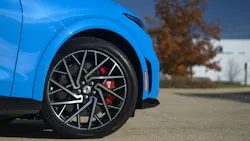
As technology advances, demand increases and manufacturers continue launching bold products, new trends are taking the high performance (HP) and ultra-high performance (UHP) tire segment to the next level.
MTD recently talked with representatives from companies that produce and sell HP/UHP tires about the latest trends shaping the industry – and how tire dealers can make sure their businesses are ready for what’s next.
MTD: What's currently the hottest trend(s) in high performance/ultra-high performance tires and why?
Brandon Stotsenburg, vice president, automotive division, American Kenda Rubber Industries Co. Ltd.: Trends in the performance tire market have been remarkably similar for a long time; compounds and construction upgrades to meet the needs of driving competition, more powerful vehicles and larger rim diameters. The rise in electric vehicle usage has required a change in performance tires. The high horsepower, high torque motors and heavier gross vehicle weights of EVs stress tires differently than internal combustion engine vehicles. Along with those changed demands on the carcass, the compound demands changed, as well. Low rolling resistance compounds were initially developed to reduce fuel consumption, but now low RRC compounds need to handle the grip required of a UHP tire while accounting for the immediate power of an electric motor and vehicle range, as well. While many tire manufacturers focused on maximizing range with their EV offerings, mileage and consumer value were often left on the chopping block.
Another key trend is how CUVs are impacting the UHP market. In recent years, many of the top selling sizes in the UHP A/S and UHP summer segments fit CUVs. In 2015, only eight vehicle brands had CUV/SUVs with W or Y speed-rated tires at OE. In 2025, 29 vehicle brands produced 91 models with W/Y ratings. Furthermore, in 2015 only two vehicle brands and three models used 22” rim diameters with W and Y speed-rated tires at OE. In 2025, that has exploded to 15 vehicle brands and 47 models. Mainstream CUVs like the Ford Explorer, Hyundai Tucson, Jeep Grand Cherokee and Mazda CX-90 (among others) are now supplied with UHP A/S tires at OE. While not a UHP trend, it should be noted that as the grand touring A/S segment adds more W-rated aftermarket options. It is important for dealers to distinguish between W-rated touring and W-rated performance tires. They are designed differently and have different strengths and weaknesses.
The customer is the key. A consumer with a 2018 Lexus RC350 (235/45R18 94Y), a 2018 Tesla Model 3 Performance (235/45R18 98W) and a 2018 Hyundai Kona (235/45R18 98V) will likely have different tire needs. However, it is more likely that the Hyundai customer will be offered a tier four UHP tire based on price, and the Lexus customer will get a higher tier UHP tire recommended based on the vehicle being a luxury coupe and the factory Y-rated tire. There are multiple reasons why a consumer with any of these vehicles could use a touring tire or a performance tire. It's important to qualify the customer to provide the best option for that particular driver.
Dan Cohen, X Comp director of motorsports/marketing, American Pacific Industries Inc.: I believe the latest trends in ultra-high performance tires can be divided into two categories: one that pertains to consumers seeking year-round performance and durability, and one that focuses on enthusiasts wanting advanced compounds and the fastest lap times. We see the UHP market growing substantially due to the increasing demand from sports cars, luxury SUVs and EV vehicles. The goal is to deliver a tire that can provide all-season capability, while still incorporating motorsport technology for the street. The other is focusing on advanced grip and speed. Years before, high horsepower OE vehicles were a myth. Yet now, most SUVs come packed with more power and torque than the consumer will ever need. This supports the need of a year-round UHP tire. For the die-hard enthusiasts, including drifters and track rats, a growing presence of automotive tuning, racing events and endless modifications have increased the demand for a faster, responsive performance segment.
Keith Calcagno, chief strategy officer of proprietary brands, American Tire Distributors: The ultra-high performance market continues to evolve with new applications – especially electric and hybrid vehicles, along with trending larger-rim SUVs and CUVs in gas-powered models. As these vehicles become more common, demand is increasing for UHP tires engineered to meet unique performance requirements, including added weight, instant torque and low rolling resistance. Much of this innovation is still optimally achieved through advanced UHP tread pattern design. Across the category, there’s a strong push to optimize the balance between traction and longevity while elevating the overall driving experience. Drivers now expect improvements in grip, handling, noise reduction and ride comfort – without compromising treadwear or durability. Advanced silica-rich compounds, refined tread patterns and noise-dampening technologies are helping manufacturers deliver on those expectations. There’s also heightened focus on wet and dry grip, as consumers become more informed and prioritize all-weather safety.
At the same time, sustainability is becoming a key performance metric. The industry is adopting bio-based oils, natural rubber and recycled materials to reduce environmental impact, while exploring smart technologies such as embedded sensors and AI-driven design to improve safety and efficiency. Concepts like improved ride quality, run-flat tires and even airless designs are also shaping the future of performance.
Michael Mathis, president, Atturo Tire Corp.: When you think about UHP tires, the typical vehicles that come to mind are Porsche, BMW, Mercedes, import tuners, Corvette, Camaro and Mustang. Today’s UHP market is seeing an expansion to new applications. This includes high performance SUVs like the Ford Explorer ST, BMW X5M or Dodge Durango SRT. Atturo is also seeing a growth in demand for UHP tires for EVs. Vehicles like the Tesla Plaid and Model 3 Performance as well as the new Hyundai Ionic and many options from brands like Audi, BMW and Porsche. This is the area of biggest expansion in the UHP segment – using these tires on more types of vehicles.
Todd Chapman, senior product manager, OE business strategy, Bridgestone Americas Inc.: The hottest trend in high performance and ultra-high performance tires is the surge in track-oriented, road-legal 200 treadwear (200TW) tires designed for grassroots motorsports. Participation in autocross, track days and time trials continues to grow, with new series and events giving everyday enthusiasts more opportunities to push their vehicles to the limit. As a result, drivers are demanding tires that deliver maximum grip, faster lap times and long-lasting wear life.
Nate Dodds, product manager for performance tires, Continental Tire the Americas LLC: We see multiple trends in the ultra-high/high performance tire market, but it all starts with the vehicle needs. There are clear trends of 19"+ rim diameters, growth of electric vehicles and continued growth in performance CUV and SUVs. Additionally, we see higher speed rated tires and higher load requirements on the tire as vehicles get heavier due to additional safety requirements and technologies. To meet these needs, the “ultra hot” ultra-high performance all-season segment remains a strong go-to option for the customer. While the market is not as large as the ultra-high performance all-season market, the demand for the fastest “track” tire in the ultra-high performance summer tire market remains high. Specifically, the demand for competition track tires that meet competition requirements of 200 UTQG treadwear. Consumers want the fastest tire out there on the market, which is creating shorter and shorter product lifecycles. Manufacturers are constantly having to adapt and improve to stay on top.
Josh Benson, vice president, First Choice Sourcing Solutions: We are seeing HP/UHP tires gaining traction in the U.S. The economic climate has seen drivers shift to UHP tires that maximize real performance while still delivering year-round usability, which makes UHP A/S tires especially appealing for daily driving. We expect this shift to continue through 2026, as shoppers look for tires that deliver confident handling, durability and comfort without the trade-offs traditionally associated with the performance categories.
Ernie Boehm, director of sales, Fury Tires: Trends in this market include tires intended for drifters, road racers, performance SUV drivers, American muscle owners, performance truck builders, diesel torque junkies and more. Another trend that perhaps no one else saw coming has been large‑vehicle ultra‑high performance track tires. There continues to be a demand for all‑weather UHP tires built for everyday driving. Wet or dry, hot or cold, track day or Tuesday commute, drivers want a tire that doesn't force compromises.
David C. Poling, vice president for R&D and technical, Giti Tire (USA) Ltd.: The current hot trend for UHP tires actually centers around a cold trend. Cold wintery conditions are not conducive to what most would categorize as UHP A/S. If you have ever driven one of these tires in true winter conditions, then you know that they just can’t perform like a good all-season tire. But what if they could? The reality is that it’s easier to turn a good all-season tire into a W-speed rating than it is to turn a W-speed rating summer tire into a traditional UHP A/S. So, the hot trend in UHP tires is to make them good in the cold.
Jenny Walker, director of product and consumer planning, Goodyear Tire & Rubber Co.: Drivers today expect more than sharp handling and traction. They want ride comfort, longer tread life and year-round versatility.
David Wang, managing director, Gripmax Tires Inc.: The current HP and UHP tire market is being shaped by several dominant trends driven by changes in vehicle technology, consumer behavior and regulatory pressure. One major trend is holistic performance balance for wet grip, handling and wear life. Modern HP and UHP tires are no longer developed solely for extreme dry-road grip or top-speed capability. Instead, manufacturers are focusing on balanced overall performance. Advanced rubber compounds and more sophisticated tread designs are being used to broaden the usable performance window rather than chasing a single peak metric. We also see rapid growth of UHP all-season tires. Traditionally, UHP tires were almost exclusively summer tires. Today, UHP all-season tires are growing rapidly, especially in North America and other temperate regions. These tires aim to deliver high-performance handling characteristics, reliable wet traction, light-snow capability and a reduced need for seasonal tire changes. Another major trend is UHP tires optimized for electric vehicles (EVs). The rise of high performance electric vehicles has introduced new technical requirements for UHP tires, including much higher instant torque loads, increased vehicle weight due to batteries and unique stress from regenerative braking. As a result, EV-oriented UHP tires require stronger internal structures and sidewalls, heat-resistant and wear-optimized compounds and lower rolling resistance to preserve driving range. Finally, we also see trends in advanced materials and sustainability. Even in the performance segment, sustainability has become unavoidable. Leading manufacturers are investing in high-silica and advanced polymer compounds, lower rolling-resistance formulations and recycled or renewable raw materials. These innovations improve wet grip and wear while also reducing environmental impact.
Customers increasingly expect one tire to perform well both on spirited drives and in daily commuting scenarios, rather than owning multiple specialized tires. They want performance without the inconvenience of switching tires seasonally, while still retaining sporty driving dynamics.
Andrew Dunn, product and market intelligence specialist, Hankook Tire America Corp.: The top trends in high and ultra-high performance tires today center on delivering maximum performance while maintaining broader everyday usability. Manufacturers are leveraging high-silica and multi-compound tread formulations, along with optimized contact patch design, to maximize dry grip, wet traction and braking performance while improving stability at high speeds. There’s also growing emphasis on tires that can handle the added weight, torque and instant acceleration of electric vehicles, while reducing road noise and improving efficiency. At the same time, sustainability is becoming more important, with brands incorporating eco-conscious materials and processes without sacrificing performance. Overall, the trend is toward high performance tires that excel not just on the track, but in real-world driving.
Shawn Denlein, president of sales and marketing, Kumho Tire U.S.A. Inc.: The high performance tire market is a representative segment that grew in earnest in direct response to original equipment (OE) trends driven by car manufacturers. Even as recently as 20 years ago, OE supply products were centered around T‑speed ratings, but the market has since transformed, with H/V speed ratings now forming the mainstream. The primary performance requirements in this market are all‑season capability, ride comfort and wear resistance. Another niche market product category that is newly shaping in this segment is a product engraved with 3PMSF, featuring significantly enhanced snow performance. Due to the traditional trade‑off between snow performance and wear resistance, these products initially served as a niche alternative to snow tires. However, as technology has advanced and the limitations in wear performance have been overcome, these products have begun to firmly establish themselves in the market. With snow performance greatly enhanced, these tires can be used effectively in winter, and as their wear competitiveness has improved to a level comparable to grand touring products, they are increasingly leading changes in the high performance zone.
It is also necessary to pay close attention to changes in the UHP market. Unlike in the past, when growth in this segment was led primarily by sports sedans and tuned vehicles, car manufacturers are now also driving the growth of this market. Overall instant acceleration performance of ICE vehicles has improved significantly, and alongside the rapid growth of EVs with very high instant acceleration, tire manufacturers continue to commercialize technological advancements aimed at improving traction performance. In the UHP market, particularly the all‑season UHP segment, W‑speed‑rated products have generally been the mainstream. However, as vehicles with increasingly high instant acceleration continue to be mass‑produced, products are being introduced that go beyond the durability limits of traditional W‑speed ratings – even further with Y‑speed and (Y)‑speed‑rated tires.
Attention should be given to the fact that products capable of withstanding such extreme speed limits and durability requirements are likely to lead the future UHP market. As the maximum speed threshold increases, the durability limits expected of tires also rise with extended limitation of performance itself, which can be seen as contributing to an overall improvement in safety margins. Alongside advances in vehicle performance, tire technology continues to progress, and this progression will serve as a clear benchmark for evaluating advancements in core tire technologies.
Adam Homan, development engineer, Linglong Americas Inc.: The high performance and ultra-high performance (UHP) tire market is dynamic, with trends driven by vehicle technology, consumer priorities and regulations. One major trend is the electric vehicle (EV) tire revolution. UHP all-season tire development is the increasing focus on EV compatibility, as manufacturers adapt designs to handle heavier vehicle weights, instant torque and demands for low rolling resistance to maximize battery range while maintaining year-round grip in dry, wet and light snow conditions. Under this trend, tires marked with 'EV,' 'HL' (high load), 'EV-ready' and 'EV-compatible' are getting popular. We’re also seeing a rise in the all-weather performance category. The all-season is being challenged by the newer "all-weather" performance tire. Additionally, we see the 3-Peak Mountain Snowflake symbol becoming a key differentiator and a hyper-focus on wet weather performance. Advances in tread compound technology and tread pattern design are delivering dramatic improvements in wet handling and hydroplaning resistance.
Consumers are also seeking longer treadwear in UHP segments. The historic trade-off between grip and longevity is being redefined. Tire manufacturers are using new polymers and silica compounds, along with asymmetric tread patterns that optimize wear distribution. Warranties of 40,000 to 50,000 miles on UHP all-season tires are now common, promoting more of a daily driver usage. Additionally, the influence of SUVs and CUVs are pushing all-season category evolution, with larger rim sizes (17-22 inches) dominating and more SKU options emerging to meet diverse consumer needs.
Walter Chen, product planning specialist, Maxxis International-USA: UTQG 200 extreme summer tires are the hottest tires in the UHP market. These tires are being released more often, each reaching the market with the goal of delivering higher dry performance than ever before; the 200TW segment is currently the most popular choice among driving enthusiasts. Most grassroots racing organizations have introduced UTQG 200 minimum treadwear rules to keep competition affordable. In response, tire manufacturers have continued to push the limits, developing tires that deliver faster dry lap times while retaining decent wet performance, consistency and life. Beyond the racetrack, street enthusiasts, who are heavily influenced by what racers use, choose these tires to get optimum performance from their sports cars and sports sedans.
Steve Calder, product category manager, Michelin North America Inc.: Aesthetics are becoming a major differentiator in the high performance and ultra‑high performance tire segment. Manufacturers are developing new technologies that give industrial designers far more freedom to create high‑contrast, dimensional features across both sidewalls and tread patterns. These visual enhancements not only signal performance but also strengthen brand identity.
Jay Lee, director of product and pricing, Nexen Tire America: The hottest trends in the HP/UHP tire segment are driven by the rapid growth of EVs, advances in material science and AI-based development. First, EV-optimized HP/UHP tires are becoming essential as electric vehicles are heavier and deliver instant high torque. Modern HP/UHP tires are being designed with reinforced structures, torque-resistant compounds, lower rolling resistance and enhanced noise reduction to balance performance, durability, efficiency and comfort. Second, advanced compound and material technologies are elevating performance beyond traditional rubber formulations. High-silica compounds, functional polymers and high-strength reinforcements improve wet grip, high-speed stability, heat resistance and wear consistency, creating a more balanced and premium HP/UHP performance profile. Third, AI- and simulation-driven tire development is transforming how HP/UHP tires are designed. Virtual testing and machine-learning optimization allow faster development cycles, precise performance targeting and vehicle-specific tuning, enabling manufacturers to deliver highly specialized and refined performance tires more quickly. Overall, HP/UHP tires are evolving toward EV-focused, material-driven and digitally engineered solutions that deliver higher performance with greater precision and efficiency.
Dave Johnston, director of portfolio, pricing and business planning, Nokian Tyres Inc.: Drivers of high-performance vehicles are increasingly interested in tires that deliver a more balanced experience for daily driving, rather than just adrenaline on the weekends. We see the UHP all-season segment continuing to grow in response.
Rob Montasser, vice president of sales, Omnisource/Radar: Demand is shifting from traditional UHP summer tires toward UHP all-season options as drivers seek year-round confidence without sacrificing sharp, sporty handling. At the same time, the continued growth of EVs is accelerating the need for UHP tires engineered to handle higher loads, instant torque and a quieter ride.
Ian Coke, vice president of technical strategy and customer relations, Pirelli North America Inc.: Today, the hottest trends in the high performance and ultra-high performance tire segment are being shaped by how vehicles themselves are evolving, particularly through electrification, digital integration and sustainability. Electric and electrified performance vehicles also place very different demands on tires, from instant torque and higher vehicle weight to the need for reduced noise and improved efficiency. Digital connectivity is also redefining the role of the tire. Another key trend is the integration of sustainability into ultra-high performance products.
Jack McClure, segment PLT product development manager, Sailun Tire Americas: The ultra-high performance (UHP) tire market is increasingly shifting toward UHP all-season offerings, driven by growth in performance-oriented SUVs and CUVs. Consumers are seeking a balance of sporty handling, ride comfort, low noise and year-round usability, including light snow performance. Vehicle electrification and higher torque outputs are accelerating demand for EV-optimized tire technologies, such as low rolling resistance and enhanced durability. At the same time, manufacturers are advancing next-generation silica-based compounds and intelligent tread designs to enhance efficiency, performance and wear. In parallel, the market is also seeing increased adoption of larger rim diameters, with fitments commonly ranging from 19 to 24 inches as OE fitments.
Mike Park, assistant director of market intelligence and pricing, Tireco Inc.: The hottest trend in today’s high performance and ultra-high performance tire segment is the move toward “performance with fewer compromises.” The market expectations come with a broader scorecard that includes wet braking, noise, durability and efficiency as more performance fitments are going onto heavier, higher-torque vehicles including performance EVs. That shift is pushing UHP toward higher load capability and compounds designed to handle instant torque without compromising wear, lower rolling resistance and features that reduce cabin noise. The UHP all-season category continues to expand quickly as drivers look for one set of tires that still feel like a true performance product in dry and wet conditions, but can better handle temperature swings and occasional light snow without stepping down into a traditional touring tire. That demand is driving UHP all-season designs to more sophisticated compounds and tread patterns, and it is accelerating size coverage growth to meet the needs of modern performance sedans, crossovers and EV applications.
Joaquin Gonzalez, Jr., president, Tire Group International LLC: Manufacturers are focusing on advanced rubber compounds and innovative tread designs. They’re creating new materials that enhance grip and durability, often using silica for better wet traction and lower rolling resistance. Asymmetrical tread patterns are also gaining traction, providing better handling and stability in various conditions. Another big trend is the rise of all-season/all-weather performance tires, designed to perform well in both dry and wet weather, making them super versatile. These all-season tires can compete with traditional summer tires, which is a game-changer for many drivers.
Cameron Parsons, technical field and business development manager, Toyo Tire U.S.A. Corp.: Automotive technology has made strides in new developments over the last decade, and the tire market is constantly evolving to match. Even some entry-level cars of today can outperform the upper tier from not long ago, upping the demand for higher speed ratings and wet and dry performance. These developments aren’t restricted to just performance, as modern cars deliver better comfort and less noise than ever before. This adds to the challenge of increasing performance while also maintaining a quiet and comfortable ride for any vehicle occupants. To top it off, EV presence continues to grow along with hybrid powertrains, significantly adding to the vehicle weight and potential instant torque delivery. These characteristics thus add durability, low rolling resistance and load carrying capacity to the tire priority list. Overall, the potential market for high performance and ultra-high performance tires is growing far beyond the sportscar segment. Entry-level daily commuters, luxury performance cars and everything in between is now a potential HP/UHP application. This is broadening the HP/UHP tire category so much that we’re seeing unique subcategories to fulfill the needs of every customer, including products like UHP all-weather tires that deliver strong wet and dry performance, with a 3-Peak Mountain Snowflake rating.
Paul Sepetjian, chief commercial officer, Turbo Wholesale Tires LLC: Sizes that were once considered aftermarket in the ultra-high performance segment are now being seen coming on original equipment with the car manufacturers. A 23-inch tire, which was not a prominent rim size in the past, is now being seen as OE for cars like Range Rover and other SUVs. We are also seeing tire manufacturers get creative and start implementing UHP tires in the EV market.
Ryan Parszik, product planning manager, Yokohama Tire Corp.: With tires that need to support both ICE and EV vehicles that are heavier, faster and deliver instant torque, we’re engineering HP/UHP tires with stronger constructions, higher-grip silica-rich compounds and lower rolling resistance while maintaining wear. OEMs are demanding tires that hit performance, efficiency and environmental targets simultaneously.
About the Author

Aden Graves
Associate editor
Aden Graves is MTD's associate editor. A graduate of Kent State (Ohio) University's award-winning School of Media and Journalism, Graves holds a bachelor's degree in journalism and another bachelor's degree in communication studies.