Key Highlights
- Ontario increased its tire management requirement from 65% to 80% for the 2026 performance year, but the immediate effect on the province’s existing scrap tire backlog remains uncertain.
- Beginning in 2027, producers will have to maintain approximately 2,200 additional collection sites, bringing the required network to roughly 6,500 sites, with new restrictions on when reported sites can be removed or replaced.
- Tire dealers and other collection sites continue to report service disruptions and growing inventories, while the regulation does not guarantee that every tire-generating business will be included in a PRO collection network.
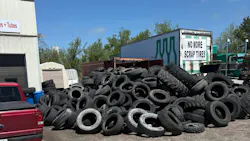
Tirecraft Ontario’s delivery trucks used to come back with empty space. Increasingly, that space is filled with scrap tires.
As routine scrap tire collection has become less predictable across Ontario, Tirecraft has begun using its own distribution network to move tires from stores back to its distribution center. Trucks delivering new tires to Tirecraft locations use available space on the return trip to bring scrap tires back with them.
The workaround keeps tires moving, but creates work that previously wasn’t necessary. Tires have to be loaded at the store, unloaded at Tirecraft’s distribution center, stored and eventually loaded again for processing.
“It’s just a lot of extra handling that has to happen,” says Christine McClay, president of Tirecraft Ontario.
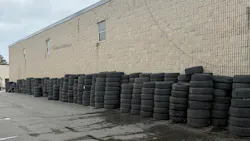
Tirecraft’s network includes nearly 100 Ontario locations, and McClay says all have experienced some level of collection disruption. At Tirecraft Ontario’s distribution center, she estimates the company is storing several thousand scrap tires, compared with only a few hundred under normal conditions. At many stores, inventories are roughly twice normal levels.
At one downtown Toronto store, approximately 300 scrap tires have accumulated — enough that the location has lost the use of a service bay because there is nowhere else to put them.
Similar problems are appearing elsewhere in Ontario’s tire recycling system. Interviews conducted by MTD with tire dealers, a scrap tire hauler, a scrap tire processor and the Ontario Tire Dealers Association (OTDA) show scrap tires getting stranded at several points in the system. Dealers report sporadic or missed pickups. One hauler says limits on the volume he can move have forced him to ration service. One Ontario processor has dramatically increased its sourcing of tires from the United States to maintain the steady supply of raw material its operation requires.
The Resource Productivity and Recovery Authority (RPRA), which administers and enforces Ontario’s Tires Regulation, told MTD that “collection delays are occurring across the system.”
As a result of the mounting backlog, Ontario has now adopted new requirements intended to get more scrap tires moving. On Sept. 21, the province finalized amendments that increase the amount of tire material producers must manage beginning in 2026 and expand the collection networks they must maintain starting in 2027.
But the effect of those changes on Ontario’s existing backlog — and on the dealers already storing, moving and in some cases paying extra to dispose of scrap tires — remains uncertain.
How big is Ontario’s backlog?
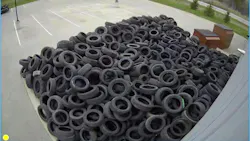
There is no official province-wide count of the tires currently waiting to be collected or processed.
RPRA told MTD it does not have an estimate of the number or tonnage of tires backlogged at dealers, haulers or other collection sites. The regulator also said 2025 recovery data will not be published until this fall.
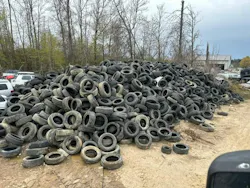
OTDA has developed its own estimate based on what it is seeing through members and other industry contacts. Adam Moffatt, executive director of OTDA, estimates Ontario ended 2025 with roughly two million scrap tires accumulated outside normal recycling flows. About half of that estimate came from two major stockpiles — one in the Sudbury/Azilda area and another in the Stittsville/Ottawa area — that Moffatt estimated contained roughly 500,000 tires each. OTDA estimated another approximately one million tires remained at dealerships, automotive facilities, municipal depots and other collection sites throughout the province.
The two large stockpiles are being addressed separately. Moffatt told MTD tires were being removed from the sites, although significant quantities remained when he was interviewed.
Before the Sept. 21 amendments were announced, OTDA estimated another one million to 1.25 million tires were backlogged at collectors and haulers during 2026, excluding the two large 2025 stockpiles. Moffatt projected that, if collection conditions remained unchanged, the backlog could reach 2.5 million to 3.5 million tires by year-end.
That projection predates the new requirements and does not account for any increase in collection activity that could result from them.
OTDA’s figures are industry estimates, not a regulatory count, but municipal stockpiles and service restrictions provide additional evidence of collection pressure across the province.
The Peterborough County/City Waste Management Facility reported in August that it was storing approximately 8,000 to 9,000 scrap tires, compared with a normal inventory of about 3,000 to 4,000. The City of Peterborough attributed the increase to delays within Ontario’s tire recycling system.
Toronto has stopped accepting tires at its drop-off depots until further notice. The Regional Municipality of Durham suspended tire acceptance at its waste management facilities in June because of overstock, saying tires were arriving faster than third-party haulers and processors were removing them. Wellington County also temporarily paused tire acceptance after its facilities reached capacity.
The collection pressure has continued since Ontario finalized its latest regulatory changes. On Sept. 29, Orillia City Council approved temporary restrictions after approximately 5,000 scrap tires accumulated at the city’s waste diversion site. Approximately 70% of the tires at the site were commercial tires. The city suspended commercial tire drop-offs and limited residential customers to four tires per month until collection service stabilizes.
When municipalities stop accepting tires, consumers lose another disposal option. McClay says one Tirecraft store experienced the consequences firsthand. After its local municipality stopped accepting tires, employees began arriving in the morning to find tires dumped outside the dealership overnight.
Why scrap tires piled up
Ontario has regulated scrap tires through an extended producer responsibility, or EPR, system since 2019. Companies that supply tires to the province are responsible for establishing systems to collect and manage used tires, either themselves or through producer responsibility organizations, or PROs.
The Ministry of the Environment, Conservation and Parks develops the province’s producer-responsibility policies and regulations. RPRA administers and enforces those requirements.
Before the current backlog developed, Ontario changed the rules governing tire collection and management on Jan. 1, 2025.
Through 2024, producers in the all-tires category faced two separate requirements. They had to collect a weight of used tires equal to at least 85% of their three-year average tire supply and recover — through reuse, retreading or processing — at least 85% of the tires they collected.
Beginning in 2025, Ontario eliminated the minimum collection-weight requirement. Instead, producers were required to manage tire material equal to 65% of their three-year average supply through 2029, with the requirement originally scheduled to increase to 70% in 2030.
Ontario’s latest amendments increase that management requirement to 80%, effective for the 2026 performance year and subsequent years. They do not restore the separate minimum collection-weight requirement eliminated in 2025.
When the province finalized the 2025 changes, it said the amendments were intended to give producers more flexibility, reduce regulatory burden and simplify requirements. But Ontario entered that new system with an existing collection shortfall.
RPRA’s public data show that in 2024, producers in the all-tires category reported collecting 149,837.55 metric tons of tires, for a 73.49% collection rate against the 85% requirement. At the same time, producers exceeded the separate recovery requirement, reporting a 90.11% recovery rate. The collection requirement was not achieved in any year from 2019 through 2024, while the 85% recovery requirement was met each year.
The 2025 amendments didn’t create Ontario’s collection shortfall. They changed how the province regulated a system where that shortfall already existed, while the collection network also changed.
RPRA told MTD that the 2025 amendments reduced the minimum number of required collection sites to 4,332, compared with 4,872 under the previous version. They also gave producers more flexibility in meeting collection-system requirements, including through collection events and alternative sites in neighboring municipalities. Those requirements will change again in 2027.
Under the Sept. 21 amendments, approximately 2,200 additional collection sites will be required, bringing the provincial requirement to about 6,500. At least 220 of the additional sites must be located in northern Ontario.
PROs will also be required to report their planned collection networks to RPRA by Jan. 1 each year, beginning in 2027, and the new rules limit when reported collection sites can be removed or replaced during the year.
RPRA says producers and PROs must also continue collecting tires from sites included in their reported collection systems even after minimum management requirements are met. However, while producers are required to maintain collection networks that meet provincial accessibility requirements, neither the existing regulation nor the Sept. 21 amendments guarantee that every individual tire-generating business will be included in a network.
For dealers, the question is whether the expanded network and greater restrictions on changing collection sites will improve access for tire-generating businesses that currently do not belong to a collection system — and how quickly.
Where tires stop moving
For Tirecraft Ontario, collection problems existed before the 2025 amendments, but McClay says service deteriorated more noticeably beginning in fall 2025 and continued into 2026.
Previously, pickup schedules generally reflected the needs of each store. A high-volume dealership might have a trailer exchanged when full, while an urban location might receive weekly service.
“Our stores were getting very regular pick-up before,” McClay says. “There were very few issues with the program.”
When MTD interviewed her before the latest amendments were finalized, she described service as “extremely sporadic.” Some Tirecraft locations had reported going a month without a pickup and unsuccessfully calling for emergency collection.
The problem looks different from the perspective of a hauler. Fabiano Sales, of ANA Tire Recycling, says the amount of program tire volume he is allocated to move has been reduced by roughly half since May 2026.
Before the reduction, Sales built routes around customers requiring weekly, biweekly or monthly collection. Now, he says, much of his work consists of responding to emergency calls and deciding which customers and areas he can continue serving within the volume available to him.
Sales says his processor communicates a monthly tonnage limit on the program tire volume he can move under the PRO arrangement. Once he reaches that limit, he says he cannot deliver additional program tires to the facility until more volume becomes available.
Sales’ volume limits have reduced the amount of collection service he can provide and affected his workforce. Sales says he has scaled his operation back to just himself.
A dealer can therefore experience reduced or delayed collection even when no PRO has specifically told the hauler to stop servicing that location. The hauler may still have customers requesting pickups and the ability to collect more tires, but a limited amount of material it can move through a particular commercial arrangement.
The new 80% management requirement could increase the amount of tire material moving through the regulated system. How quickly it translates into larger allocations for haulers like Sales remains uncertain.
An Ontario processor looks to the U.S.
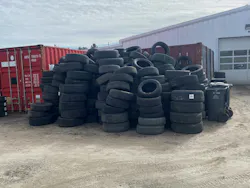
Processing capacity adds another layer to Ontario’s tire collection shortfalls.
Granulum Inc. President Kyle Gregoire says his Windsor, Ontario, crumb rubber operation can process approximately 200 tonnes of scrap tires per week — roughly 20,000 tires.
Gregoire describes Granulum not simply as a tire recycler, but as a manufacturer. "I’m not a recycling company,” he told MTD. “I’m a crumb production company.”
Granulum supplies crumb rubber to manufacturing companies in Ontario, which means the operation needs a consistent supply of tire stock every week — regardless of how many scrap tires Ontario consumers generate in a given month.
At the same time, its sourcing has changed dramatically this year. Gregoire says approximately 15% of the feedstock Granulum required in 2025 came from the U.S. That figure has climbed to roughly 70% in 2026.
Granulum’s experience illustrates that Ontario-generated scrap tires can accumulate at dealerships and other collection sites while an Ontario processor increasingly relies on imported U.S. tires to maintain production.
However, Gregoire cautions against assuming Granulum’s experience reflects every processor in the province. The company is located directly across the Detroit River from Michigan, making U.S. supply particularly accessible.
The province considered additional measures intended to encourage more tire processing within Ontario during its latest regulatory review but did not adopt them, citing mixed feedback and the need for additional analysis of local processing capacity.
What the backlog costs tire dealers
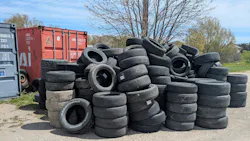
For tire dealers, collection disruptions translate into additional labor, lost storage and service space and, in some cases, another bill to have tires removed.
Private collection remains an option. RPRA told MTD that nothing in the Tires Regulation prohibits haulers or processors from entering private collection agreements with tire-generating businesses.
Gregoire says Granulum has offered a private collection option for dealers in its region, arranging collection and processing for roughly $5 Canadian per tire. Sales estimates a comparable private arrangement through his operation could cost a dealer roughly $4 Canadian per tire when hauling and processing are combined.
At least one Tirecraft associate dealer is already paying extra. McClay says the dealer recently told her he is paying an additional $2 per tire to have scrap tires collected after being told the charge was necessary if he wanted the tires removed.
“He just thought it was standard process,” she says.
For McClay, the larger issue is that Tirecraft dealers are already bearing recycling costs through the tires they purchase.
“For me, it’s the integrity of the program,” she says. “There’s a program in place. The program’s not doing what it needs to do. So we’ve already paid for this.”
Even Tirecraft’s internal workaround carries a cost. Using otherwise empty truck space to retrieve scrap tires may reduce the immediate storage problem at stores, but employees still have to load and unload the tires. Tirecraft has to provide storage space at its distribution center. One dealer has lost productive bay space, while other locations have devoted more property to scrap tire inventories.
Those growing inventories can also create problems beyond added costs and lost productivity. McClay says some Tirecraft locations have faced attention from bylaw enforcement officials and fire departments because of the amount of scrap tires accumulating on their properties — pressures that could intensify as Ontario moves into winter tire season.
The new rules
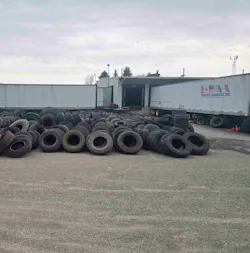
Ontario’s Sept. 21 amendments are intended to increase collection and reduce disruptions. The most immediate change raises the management requirement from 65% to 80% for 2026 and subsequent years.
Beginning in 2027, the province will also require approximately 2,200 additional collection sites and restrict when reported collection sites can be removed or replaced. MECP says the expanded network is intended to give more tire-generating businesses access to collection service and provide greater stability for businesses already in those networks.
The amendments also include additional financial reporting requirements for PROs and remove the $1 million cap on administrative penalties for violations occurring after the amended regulation was filed.
The final rules do not include everything Ontario originally proposed. MECP did not adopt a provision that would have required PROs to collect tires from any site requesting service once at least 50 tires had accumulated, with guaranteed pickup times. It also rejected a proposed requirement that collected tires be managed within three months.
The ministry said consultation feedback indicated the broader call-in requirement would be overly prescriptive, complex and potentially burdensome. It cited the need for flexibility in declining to impose the three-month management requirement.
OTDA welcomed several pieces of the final rule but said questions remain about how quickly they will improve conditions.
“Increasing the management target from 65 to 80 percent should result in more tires being collected, but we need MECP and RPRA to release year-to-date collection data before we can determine how much additional collection will actually be required and take place,” the association said in a statement provided to MTD.
OTDA also welcomed the expanded collection network and greater financial reporting requirements but said historical data are needed to determine how the additional sites compare with the system that existed before the 2025 amendments.
Stakeholders also question how quickly collection capacity can respond if more volume begins moving through the system.
“For much of this year, tire haulers and processors have been operating under reduced volumes and quotas, resulting in reduced services, parked equipment and staff layoffs,” OTDA said. “Some of that capacity cannot be restored overnight.”
Sales’ experience illustrates the concern. After his allocated volume was cut roughly in half, he reduced his workforce to just himself.
Even if the higher management requirement results in greater collection volume, rebuilding capacity could take time.
In a Sept. 23 email to MTD, Moffatt said OTDA was meeting with PROs and regulatory authorities throughout the week. As of that date, the association had not been given an indication of when or how changes would be implemented to meet the new requirements.
A week later, that uncertainty remains. As of Sept. 30, RPRA had not published the detailed implementation guidance it said would be forthcoming following the amendments.
The uncertainty around the timing and relief that the amendments could provide is particularly significant for businesses outside existing PRO collection networks. Although Ontario will require a larger network and impose greater restrictions on removing collection sites, those changes do not take effect until 2027.
The province also declined to adopt the broader call-in requirement that would have guaranteed collection service for qualifying sites requesting pickup.
Winter tire season is coming
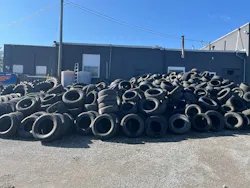
Ontario’s higher management target is taking effect as the province enters one of its busiest tire replacement periods of the year, creating another layer of concern — and urgency.
“What we see today in Ontario, this backlog of tires, we don’t typically see this time of year ... any backlog of tires,” Moffatt told MTD.
According to Moffatt, late summer is normally one of the slowest periods for scrap tire generation in Ontario and demand picks up in the fall with winter tire purchases. Sales says his normal collection volume can increase sharply during the fall tire-change period. McClay worries tires already sitting on dealership properties will become even more difficult to manage as winter arrives.
“When you get to January, you can’t clean those piles up because they’re covered in snow. So we’re just going to end up with a bigger mess going into next spring,” she says.
Ontario now has a higher recycling target and plans for a substantially larger collection network, starting next year, but dealers are generating scrap tires every day. The immediate question for Ontario tire dealers is: How quickly will the new regulatory requirements translate into reliable pickups at the businesses already waiting for tires to move?
Ontario’s Scrap Tire Backlog by the Numbers
-
2 million tires: OTDA’s estimate of the total accumulation at the end of 2025, including two major stockpiles and tires sitting at dealers, municipal depots and other collection sites.
-
500,000 tires each: OTDA’s estimate for two major 2025 stockpiles in the Sudbury/Azilda and Stittsville/Ottawa areas.
-
1 million to 1.25 million tires: OTDA’s estimate of the 2026 backlog at collectors and haulers before the Sept. 21 amendments were announced, excluding the two major 2025 stockpiles.
-
2.5 million to 3.5 million tires: OTDA’s pre-amendment projection for the year-end 2026 backlog if collection conditions remained unchanged.
-
No official province-wide estimate: As of Sept. 30, RPRA had not published an estimate of the number or tonnage of tires currently backlogged. The regulator told MTD that 2025 recovery data will be released this fall.
About the Author
 Sara Welch
Sara Welch
Managing Editor
Sara Welch is Modern Tire Dealer's managing editor. She is an award-winning journalist who covered agriculture in Ohio, Pennsylvania and West Virginia for 10 years and sports for five years before coming to MTD. She can be reached at [email protected].