MTD Flashback: 'A Man Never Hits Bottom'
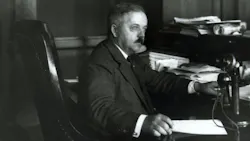
Editor's note: this article orginally appeared in the May 1938 issue of MTD. It was written by then-MTD Editor Jerome Shaw.
When in the latter part of February, word came out of Akron that Frank A. Seiberling at 78 had retired as president of Seiberling Rubber Co. in favor of his son, J. Penfield Seiberling, those who know their rubber business and particularly the romance that was attached to the early development of the pneumatic tire could not help but recognize that one of the outstanding characters in the story of a great industry was withdrawing to the sidelines.
They sensed - and we have ventured accurately - that while F.A. may have sought retirement under the newly created office of chairman of the board of the Sieberling company, the man who founded Goodyear and who on more than one occasion demonstrated his ability to recover from almost insurmountable adversaries would be inactive in a business that represented the greater part of his life's work.
And the many admirers of F.A. Seiberling trust that his judgement and his ability will be reflected in tire industry affairs for years to come.
The world might well have ended for F.A. Seiberling in 1921. For 23 years, in the face of all obstacles, he had successfully guided the Goodyear Tire & Rubber Co. to a prominent position among the world's industrial giants. Twenty-three years before, shortly after the panic of the 90s had destroyed the family fortune, he had borrowed $3,500 and founded the company, which was to make him the most respected man in the rubber industry.
But tumbling prices and heavy inventories in the financial mire that was 1921 caused Goodyear to seek outside aid and F.A., with the welfare of his stockholders in mind, stepped out of the company which he had conceived and nurtured, in favor of banker control.
He was 61 years old, an age when most men consider the course of their lives nearly run. But the "Little Napoleon" of the rubber industry possessed infinite courage and a fighting spirit that would not let him bog down in a rut of inactivity.
"A man never hits bottom," he said and again, as he had more than two decades previously, he began plans to enter the rubber world. The result was the Seiberling Rubber Co.
Several hundred companies were manufacturing tires when the firm was organized and Seiberling was at the bottom. But the unconquerable spirit that many times before had pulled Frank Seiberling up by the bootstraps weathered the financial storms of the late-20s and early-30s and established the name of Seiberling once again. The company prospered because of the high ideals and reputation of its founder and it now ranks among the big seven of the industry.
No more courageous comeback exists in the annals of American indusry than that of Frank A. Seiberling. F.A., as he was known all the way down the list of his employees, was born Oct. 6, 1859, in the hamlet of Western Star, Ohio, a scant five miles from the present Seiberling factory. His father, J.F. Seiberling, was a manufacturer of mowers and reapers. After spending his childhood days on his father's farm, F.A. attended Heidelberg College in Tiffin, Ohio, and then with his brother, C.W., had a short stay in the trolley line business. They built the first electric trolley line in Akron.
Panic brings disaster
Then came the panic of the 90s, sweeping away fortunes as the autumn winds blow away the leaves, and F.A. was without money and equipment. The rubber industry was still gurgling in its cradle and few men realized what the future held for it. F.A. Seiberling was one of the few. With $3,500 in borrowed capital and a dilapidated old strawboard factory, he founded the Goodyear company, naming it after Dr. Goodyear, creator of the process of vulcanizing.
The going was not too easy in those early days and according to P.W. Litchfield, Goodyear's president now, "For seven or eight years, the company fought with its back against the wall and only the courage of F.A. Seiberling enabled us to carry on."
Litchfield relates a tale of Seiberling's shrewdness, which once made the late Harvey Firestone exclam, "I've followed Frank Seiberling's career in the rubber business probably more than any one person. I had to!"
Shortly after the company was founded, the Goodyear bicycle tire department was closed. A patent infringement was charged. F.A. discovered that by placing tissue paper between the fabric there could be no charge of infringement of a bicycle tire patent. With a laugh, Litchfield says, "We used all the tissue paper in Akron and sent out for more. Not only did we make a better tire, but we didn't have to pay any royalties. That shows the resourcefulness of Mr. Seiberling."
Negotiated zeppelin deal
Although he is generally not credited with the idea, Seiberling is chiefly responsible for the development of the American lighter-than-aircraft industry. He financed the first Vaniman Transatlantic Crossing Expedition and built the first ill-fated airship, "The Akron," in the Goodyear plant in 1910. At the beginning of the World War, his company was the only one in the United States prepared to build dirigibles and observation balloons. After the war, he brought the zeppelin industry to America by negotiation a contract between Goodyear and German zeppelin interests.
Recognized chiefly as an executive, Seiberling nevertheless possesses one of the greatest inventive minds in the industry. He is credited with the creation of the tire building machine, the present type of cord tire, the big pneumatic truck tire, the straight side tire, the internal hot water cure, the vapor cure, the Seiberling two-tread, air-colled tire and many other lesser developments and inventions.
Back in 1906, when the principle roads of the nation were still mud or gravel, Seiberling visualized that good roads would increase travel in automobiles and thus increase the market for tires. Later, he came one of the leaders of the Lincoln Highway Association, which began the tremendous task of financing and getting orders to build 3,100 miles of road from New York to San Francisco. Still later, he was one of the active supporters of the Pan-American Highway, which is now nearing completion. He is still president of the Lincoln Highway Association.
While building, then losing, then rebuilding his personal fortunes, Seiberling nevertheless took time to lead in the civic betterment of Akron. Still hailed as "the first citizen" of the rubber metropolis, he was recently lauded as follows in the editorial columns of the Akron Beacon Journal:
"Through 40 years of briliant success and the occasional failure that he refused to acknowledge, Frank Seiberling has constantly carried foremost his responsibility as a citizen. Akron's present recreational facilities, hospitals, parks, social welfare groups, cultural activities - there is hardly a movement for civic betterment that has not felt the imprint of his public spirit.
"Typifying Harvey Firestone's statement, 'No man has more courage or more nerve than Mr. Seiberling,' was his comeback after his exodus from Goodyear in 1921. As head of the company and as an outstanding figure in the rubber industry in America, he had scaled the heights of success. He had established textile mills, bought great cotton and rubber plantations, opened huge machine and rubber shops and in 1920 was distributing more than $200,000,000 worth of the company's products to all parts of the earth.
"Then came the industrial upheaval that closed factories and shops overnight and forced manufacturers to abandon businesses they had been years in building. Goodyear, along with many others, passed into the clutches of Wall Street. His huge personal fortune was largely gone, his work of almost a lifetime reduced to nothing. To all accounts, he was a failure. Most men in his position, at the age of 61, would have resigned themselves to an obscure old age. Not so Seiberling.
"He was not finished yet. 'If had allowed myself to brood over the matter and feel sorry for myself, I would have been utterly lost,' he says. 'Self-pity is one of the most destructive forces in the universe. Instead of accepting failure at the end, I refused to entertain such a thought. Failure is nothing to be ashamed of. It's the admission of failure that causes all the trouble. Once you've admitted you're down and out, the world will pass you by. But there are those who are always willing to give a lift to a man who keeps on fighting.'"
It was this indomitable spirit that enabled Seiberling to gather his forces and found the company that proudly bears his name. He held the pugnacious newcomer together while it made inroads into the ranks of rubber and fought its way to a place of prominence and security in an industry that knows only competition and survival of the fittest. His company breeds only loyalty and a wholehearted devotion to its principles. Democracy prevails throughout. There is a happy boast voiced by every Seiberling employee, which says there's never a closed door to any of the executive offices.
While in recent years, labor strife has almost torn the heart out of the city of Akron, when rubber plants have become war-torn shambles, Seiberling has gone peacefully on its way. Never once since its inception in 1922 has the company that F.A. built experienced the slightest of labor difficulties.
The most glorious tribute ever paid to the gray-haired dean of the tire industry took place three years ago on his 75th birthday. Every important person in rubber attended a banquet given in his honor. Tycoons of rival companies joined with old Seiberling friends from every walk of life to pay tribute to F.A. They lauded him for his many achievements with a sincerity that could be nothing but genuine and then adopted the following resolution:
'We friends and neighbors whose names appear below extend affectionate greetings to you with the sincere desire to assure you of the high esteeem in which we hold you. While the rubber world knows you better because of your outstanding service in the field of rubber, a service which has meant so much to us, we know you also as one who, for more than 50 years, has been a leader in the general development of the business, industrial and civic life of your home city, Akron. Your life among us has been a constant reminder of what courage, vision, tireless energy and perseverance can accomplish.
"We desire to express to you our respect and admiration for you as the builder with the fighting spirit, inspiring men to a renewed belief that 'conquest pursues where courage leads the way.' Your sympathetic understanding, generous hospitality and cheerful willingness to help make you indeed a friend to man.
"We wish you to go on through the years with this sincere message from your friends and fellow citizens who know your work and appreciate it. Our lives have been enriched by yours and our abiding friendship goes with you always."