Rasey Looks Back on 47-Year Career
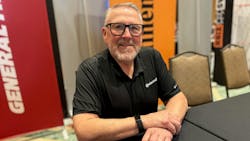
Shawn Rasey, director of global business development, Continental Tire the Americas LLC, is retiring at the end of this month after 47 years in the OTR tire segment.
Before he steps away, he has some words of advice for OTR tire dealers.
“Identify and refine those things about your business that you do better than anybody else – those things that matter to the end user,” Rasey recently told MTD. “To be able to demonstrate that you do those things in a way that the customer is willing to pay for is a formula that will continue to be something that’s hard to combat.”
According to Rasey, success in the OTR tire segment comes down to “understanding your customer’s business almost as well as your customer understands his own business.”
This philosophy was ingrained in Rasey, age 68, when he began his career at Uniroyal. In those days, it was a paper-and-pencil world. Business moved at a slower pace.
“I can remember when I first started. I was at a branch accounting department in Ohio. I’d get a phone call from a customer and maybe they had a billing discrepancy. I’d take down the information, make note of it and they’d say, ‘I’m going to send you the invoices in question.’ Four or five days later, I’d get an envelope and I’d open it up and then I could start to do something with it. I’d take action or get someone else involved and then send it back” to the customer, another four to five-day process.
The speed at which transactions take place in the OTR tire segment today, enabled by technology, is dramatically different, said Rasey.
The “digitalization” of OTR tire sales and service “was a huge development. The amount of data and the speed of data became so immediate that it changed the environment forever. It’s made things more productive. It’s made things more efficient. It also has allowed for a lot of consolidation, whether it’s the end user or within the dealer/distributor base or even within tire manufacturers.”
The level of sophistication at customers has changed dramatically, as well, said Rasey - “especially at the management level. People who are operating mines today are operating in a very fluid environment, where the demands on them are very complex. And that drives all the way down to the maintenance shop supervisor and the truck operator.
“There’s so much more information at their fingertips. Take our Conti PressureCheck system and our telematics ... a driver can know today what the air pressure and temperature of his tires are and can receive an audio or visual warning to let him know something’s not right.
“They can walk around a truck pre-inspection with our app on their phone, without ever touching a valve stem, and know if those tires need air. All of that layers more and more information and data, so you can now sit down with a mine operator and say, ‘Based on your history and based on how your tires are wearing and the kind of profiling we’ve done with our telematics and job site studies, we can make a recommendation to change tires so you can get longer tread life, be safer and be more productive.’ Digitalization has completely rewritten the rule book.”
OTR tire dealers have more tools at their disposal, as well, said Rasey. But the number of dealers in the OTR tire segment has narrowed over the decades, he noted. “When I first started, the vast majority of servicing dealers were local enterprises with one – maybe two – locations. Today, through consolidation, we have mega-dealers who are either operating on a national basis or a multi-region basis and they dominate the landscape.
“This creates more capability, more uniformity and better experiences for end users across the board. It’s a much more complete experience that the customer now gets. Thirty-five years ago, you'd have a delivery book. The tire tech would go out and he would write in the book, ‘I delivered so many tires.’ Then the billing clerk would take that and try to interpret it and create an invoice to bill the customer. Five out of 10 of these service techs ... their handwriting was illegible.
“Today, techs are on mobile devices and putting information in digitally and all of this information flows and it’s absolutely clear what happened at the mine site.”
Product quality also has exponentially improved over the decades, with rapid advancements happening in recent years, Rasey told MTD. “That has been driven in some ways by digitalization ... in the ability to do tire design work and how that’s accelerated. Modeling and dynamic modeling completely revolutionized how tire manufacturers create products and come to market.
“As equipment has gotten bigger, tires have continued to get bigger and it’s all been driven by this need for more efficiency, more productivity and driving down costs for operators,” said Rasey, noting that the largest OTR tire size in the early days of his career was 30.00x51, “which still exists, but has almost become a dinosaur.”
Looking ahead, “I think we’ll see new technologies emerge that will make things safer, faster and more economical in terms of driving costs down.”
On the tire development side, “what I can see coming really fast is artificial intelligence ... being able to search, catalog and pair tire compounds and belt package designs and tread designs and the uniformity of footprints and how to optimize all of those things. It will be so much faster than anything we’ve seen before.”
However, some aspects of working in the OTR tire segment will not change, said Rasey. That includes cultivating and maintaining customer relationships.
“If you’re selling passenger tires at the retail counter, you’re dealing with people all day, every day. But it’s a different kind of relationship when you get to the commercial truck tire side and especially when you get into OTR. Due to the nature of the products, the cost of the products, the sophistication of the products and the applications you’re trying to fit, you develop a special bond with your customers and even with your colleagues. It’s the pinnacle of where relationships, knowledge and intuition all cross together.”
Rasey plans to carry those relationships into retirement. “In the end, it’s all about people. I had a CEO I worked for and after we both left the company, he said, ‘After you leave a place, all the sales records and profits you helped generate will pass pretty quickly and someone else will step into your role. What you’re remembered for after you leave is how you treated people.’ It all comes back to people.”
About the Author

Mike Manges
Editor
Mike Manges is Modern Tire Dealer’s editor. A 29-year tire industry veteran, he is a three-time International Automotive Media Association Award winner, holds a Gold Award from the Association of Automotive Publication Editors and was named a finalist for the Jesse H. Neal Award, the Pulitzer Prize of business-to-business media, in 2024 and 2026. A past Endeavor Business Media Editor of the Year, Mike has traveled the world in pursuit of stories that will help independent tire dealers move their businesses forward. Before rejoining MTD in 2019, he held corporate communications positions at two Fortune 500 companies and served as MTD’s senior editor from 2000 to 2010.