A Look at Tread Rubber Testing
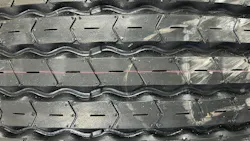
Ever wonder how tread rubber for retreading applications is tested for performance and other metrics before it's ever applied to a casing?
Josh Guilliams, vice president of consultancy, at Smithers, the Akron, Ohio-based provider of tire testing services, has some unique insight.
Guilliams, who oversees Smithers’ technical consulting team, manages client relationships and conducts in-depth investigations of rubber materials, products and components.
He says Smithers, which celebrated its 100th anniversary in 2025, has been evaluating tread rubber used in retreading processes "for as long as we’ve been offering chemical and physical testing services for rubber compounds.
"As is the case with any tread rubber, we’re evaluating performance characteristics via stress/strain, DMA, durometer and ozone testing, among others," he notes.
"A critical factor specific to retread tread rubber is processability. Because of how retreads are built, the tread compound must be lower in processability, so it can move smoothly through the extrusion barrels.
"One of the most valuable tools for assessing processability is a Mooney viscometer, which, in simple terms, quantifies the consistency of a rubber compound in the context of how well it flows in a processing environment. A rubber compound with a low Mooney value may be too soft, while a compound with a high Mooney value may be too hard.
"Another variable is Mooney Scorch, which evaluates cure time - a critical variable given the necessity of a good cure. Another factor to consider is adhesion between the retread and the tire carcass. Good adhesion is the product of optimal tensile properties and good reinforcement."
Guilliams says that as a whole, "retreaded tires can also be tested for performance and durability. Durability and endurance testing recreate the stresses of real-world operation in a controlled laboratory environment, so fleets and manufacturers can assess the resilience and performance of retreaded tires before moving forward with large-scale implementation.
"Additionally, retreaded tires can be tested for rolling resistance, a critical metric tied to reduced fuel consumption and decreased environmental impact. Given the growing importance of sustainability across the tire industry, this gives manufacturers and fleets another opportunity to make progress toward their sustainability goals.
"When optimizing rubber compounds for tires, tire manufacturers are faced with a constant balancing act. It’s virtually impossible to alter one characteristic without affecting another. When you add the processability and adhesion requirements of retread rubber, the window for optimization becomes even tighter, making retread compound development even more challenging than original tread compound development."
About the Author

Mike Manges
Editor
Mike Manges is Modern Tire Dealer’s editor. A 29-year tire industry veteran, he is a three-time International Automotive Media Association Award winner, holds a Gold Award from the Association of Automotive Publication Editors and was named a finalist for the Jesse H. Neal Award, the Pulitzer Prize of business-to-business media, in 2024 and 2026. A past Endeavor Business Media Editor of the Year, Mike has traveled the world in pursuit of stories that will help independent tire dealers move their businesses forward. Before rejoining MTD in 2019, he held corporate communications positions at two Fortune 500 companies and served as MTD’s senior editor from 2000 to 2010.