Industrial Tire Segment Creates Opportunities
Key Highlights
- Market growth is driven by increased equipment utilization, warehouse automation, and the rise of electric and automated forklifts, boosting demand for durable, high-performance tires.
- Trends include a shift toward radial tires, non-marking compounds, and smart tire technology for real-time monitoring and preventive maintenance, enhancing operational efficiency.
- Dealers are encouraged to act as trusted advisors by understanding customer applications, focusing on long-term value, and offering application-specific tire solutions to foster stronger relationships.
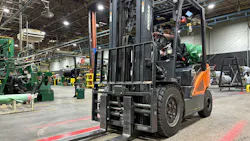
Factors impacting today’s replacement industrial tire market are as diverse as the number and variety of industrial tires that are currently available to tire dealers. Where to start?
In this MTD exclusive, industrial tire manufacturers cut through the noise as they discuss important product, technology and market trends; what end users are looking for in both products and services, and how industrial tire dealers can further enhance the value they provide.
“In the industrial sector, many operators are extending the service life of their existing equipment and postponing investments in new machinery,” says Jeff Smiley, head, wholesale distribution channels, BKT USA Inc. “This trend supports the replacement tire market, as keeping equipment in operation longer requires more frequent maintenance and tire replacement.
“We are also seeing increasing demand driven by higher activity in ports and warehouses. The continued expansion of large distribution centers has led to greater forklift utilization, thus increasing the need for high-load-bearing industrial tires.
“In addition, the ongoing shift toward electric forklifts has increased vehicle weight due to battery packs, driving stronger demand for solid tires that offer improved durability and longer service life,” says Smiley, who adds that radial tires “continue to gain traction thanks to their ability to improve operator comfort and ride quality while delivering strong performance.”
Ryan Loethen, president, CEAT Specialty Tires, says one of the biggest trends in the U.S. industrial tire market is the increasing demand for “equipment-specific tires that can perform across a wide range of operating conditions. Contractors and industrial operators want a tire designed for their machine, whether it's a telehandler, backhoe or compact loader, but they also expect it to deliver dependable performance on concrete, gravel, dirt and mixed job sites.
“At the same time, purchasing decisions are becoming more value-driven. Fleet managers, rental companies and contractors are placing greater emphasis on total cost of ownership rather than initial purchase price. They're looking for tires that deliver longer service life, minimize downtime, improve machine stability and reduce the frequency of replacements. As a result, features such as radial construction, durable tread compounds and puncture resistance are becoming increasingly important differentiators.”
“For tire dealers, these trends create an opportunity to move beyond selling on price alone. Customers are looking for guidance on selecting the right tire for their application and dealers who understand equipment requirements and operating conditions can position themselves as trusted advisors. Instead of asking, ‘What size tire do you need?’ the conversation should begin with questions like, ‘What machine are you running? What type of surface do you operate on? How many hours does it work each week?’ Those discussions lead to better tire recommendations and stronger customer relationships.
“Ultimately, success in today's industrial tire market is about helping customers lower their operating costs and maximize equipment uptime,” says Loethen. “Dealers who focus on application expertise, educate customers on the long-term value of premium tire technology and recommend solutions based on performance rather than purchase price will be well-positioned to grow their business as the industrial equipment market continues to evolve.”
“The U.S. replacement forklift tire market is experiencing steady growth, driven by industrial automation, e-commerce expansion and the rising adoption of electric and automated forklifts,” says Cara Junkins, director, OTR and ag, CMA/Double Coin. “As facilities operate for longer hours, demand is increasing for tires that deliver greater longevity and consistent performance under these demanding conditions.
“One trend tied to the growth of electric forklifts is the increasing preference for tires with lower rolling resistance, which can help extend battery life. Radial pneumatic tires generally offer lower rolling resistance and run cooler than bias pneumatic tires, contributing to a shift toward radial options in many operations that use pneumatic tires.
“Advances in tire compounding and tread design are also addressing more specialized operating requirements. For example, non-marking tires are becoming more common in pharmaceutical and food processing environments, as well as in applications where floor cleanliness is a priority. At the same time, manufacturers are developing more sustainable tires using recycled and renewable materials to meet the needs of customers focused on reducing their carbon footprint,” says Junkins.
“Another growing trend is the integration of smart tire technology. Smart tire sensors enable real-time monitoring, supporting more effective fleet management and helping operators implement preventive maintenance practices.”
A user-focused market
Troy Rudnick, president, Forklift Tire Co. Inc., says today’s industrial tire end user shops “by size and application and expect straight answers on fitment and lead time before they buy. That buyer is reshaping demand. Electric lifts and clean-floor operations keep pushing the market toward press-on solids and non-marking compounds, because a down truck or a marked-up floor costs far more than a tire ever will.
“Tariffs and import delays have turned 'Made in the U.S.A.' from a feel-good sticker into a sourcing strategy. And with new equipment priced where it is, fleets are running their trucks longer. Every one of those hours rides on replacement tires. The dealer who gets that buyer the right tire the first time wins them for the life of the fleet."
A representative from Global Rubber Industries Pvt. Ltd. (GRI) says the U.S. replacement industrial tire market is currently experiencing several significant trends, including “ongoing uncertainty driven by raw material costs, freight rates, tariffs and rising agricultural input costs” that have resulted “in a flat-to-slightly declining market, creating increased price pressure as overall demand softens. With the market pie shrinking and inventory levels remaining high across local distributors, competition has intensified, placing greater emphasis on pricing and inventory management.
“At the same time, there is a noticeable shift toward budget tire brands across the agricultural, material handling and construction segments, as end users and dealers seek more cost-effective solutions without compromising operational requirements.
Michael Dembe, vice president, OEM sales, construction, OTR Engineered Solutions, says that “many of the forces shaping the industry are extensions of long-term trends rather than entirely new developments. From tariff uncertainty to changing fleet management strategies and evolving product preferences, manufacturers and dealers are adapting to a marketplace where service, uptime and operational efficiency have become more important than ever.
“One of the biggest challenges facing the industry is navigating an increasingly complex U.S. tariff environment. Frequent changes to import tariffs have created uncertainty for manufacturers and importers, requiring companies to continuously adjust sourcing strategies, inventory levels and pricing while maintaining reliable supply for customers. However, recent tariff relief on certain imported agricultural and industrial equipment … could create an influx of foreign-built equipment coming into the U.S., which should bolster future replacement demand.
“At the customer level, fleet operators remain intensely focused on reducing operating costs and maximizing equipment uptime,” Dembe explains. “Tires represent one of the most expensive consumable categories for equipment fleets, making replacement strategies, preventive maintenance and service support critical priorities. As fleets become more geographically dispersed, many operators are looking beyond local suppliers and instead partnering with national account programs or large, multi-state commercial tire dealers that can provide consistent service across multiple locations and remote jobsites.
“Despite softer original equipment demand, the replacement tire market continues to benefit from this aging equipment fleet,” Dembe explains. “Though the OEM business remains down, we are seeing glimmers of hope for 2027. Fleets can only hold off on new equipment purchases for so long, given the paramount interest in maximized uptime and productivity.”
“Trends in the industrial tire market, specifically forklift tires, are rapidly changing,” says Jack Fenner, marketing manager for Specialty Tires of America. “Tire requirements will change as operations are now running 24/7 in warehouses that are increasing in size. Tire durability will be a bigger factor, as well as the need for lower maintenance costs.”
Fenner says owners of electric forklifts “will expect lower rolling resistance ... to improve battery life. Many warehouses are super-sensitive to a clean environment. Non-marking tires are designed for those needs.”
Service life is key
The industrial tire segment “is leaning to a cradle-to-grave way of thinking in order to enhance the life and performance of forklift tires. Sensors play a huge part in maintaining the tire to achieve the maximum benefits the tire has to offer. Reduction of downtime is a big part of the benefit.
“All in all, the industrial tire replacement business faces the same challenges associated with the life and performance of the tire and its overall maintenance,” says Fenner. “It’s a profitable business for the dealer.”
Joaquin Gonzalez, president of Tire Group International LLC, cites “the continued growth of warehousing, logistics and construction activity” as the main drivers of replacement industrial tire demand. At the same time, fleet operators are placing a greater emphasis on uptime, productivity and total cost of ownership rather than simply purchasing the lowest-priced tire.
“With advances in telematics and fleet management technology, end users have more visibility into equipment performance than ever before, allowing them to make more informed purchasing decisions. As a result, the market has seen a growing shift toward longer-lasting solid and press-on tires, particularly in forklift applications.
“The industry is also being influenced by the increasing adoption of electric and automated equipment, which requires tire solutions that deliver greater consistency, durability and efficiency. Looking ahead, technology, sustainability initiatives and predictive maintenance capabilities will continue to play an increasingly important role in purchasing decisions, especially among larger fleet operators. From my perspective, the greatest opportunities exist in forklift, skid steer and telehandler tires. These segments benefit from recurring replacement demand, attractive margins and fit well within a distributor-focused business model.
“The U.S. replacement industrial tire market is being shaped by increased use and heavier equipment utilization, warehouse automation and the continued growth of e-commerce, all of which are increasing demand for tires that deliver longer service life, greater uptime and a lower total cost of ownership,” says Travis Little, general manager, ag, construction, and industrial for Titan International Inc.’s Specialty Division.
“We are seeing customers place greater emphasis on application-specific solutions, ranging from high-cycle indoor material handling to demanding outdoor environments.
“Product development is increasingly focused on advanced tread compounds that reduce heat build-up and extended wear life, reinforced bead and sidewall designs that improve stability under load, and solid tire constructions that maximize puncture resistance and durability. Features such as resilient center compounds, innovative rim-locking technologies, deep-groove tread patterns and non-marking options are increasingly important as fleets seek improved safety, productivity, operator comfort and lifecycle value from every tire investment.”
An uncertain future
Shyam Gyanani, co-founder and director of Trident International Private Ltd., says his company has identified a number of “primary macroeconomic and operational trends currently shaping the U.S. replacement industrial market, including what he calls “geopolitical friction in West Asia” in the form of “ongoing conflict in the region (that is) projected to drive up industrial (tire) prices as current inventories are depleted and higher-cost, petroleum-based raw materials enter the supply chain. Furthermore, ocean freight and maritime shipping costs have escalated sharply over the last few months, intensifying these upward cost pressures.
He points to tariffs as another trend. “The implementation of restrictive U.S. import tariffs is driving up aftermarket costs and injecting widespread uncertainty into the sector. Because global dues have severely disrupted established supply networks, domestic customers are increasingly forced to bear the financial burden passed down by suppliers. Companies are rapidly diversifying their supply chains, moving away from vulnerable 'just-in-time' inventory models toward a more resilient 'just-in-case' approach.”
Meanwhile, he says, equipment demands continue to evolve. “Modern industrial machinery is becoming faster, heavier and more specialized, which has drastically raised initial asset acquisition costs. To justify these capital investments, fleet operators are placing immense pressure on maximizing daily productivity. The urgent need to eliminate costly vehicle downtime is accelerating the adoption of non-pneumatic tires … while drastically increasing buyer expectations for overall service life.”
“The North American region is seeing a strong material handling tire market demand, driven by warehouse automation and a strong manufacturing base,” says VL Jojan, vice president, product management, Yokohama-ATG. “These trends are increasing the demand for tires for forklifts and port machinery. Another trend we are seeing is that in warehouses, recycling, scrap and port environments where downtime is costly, buyers are increasingly favoring solid resilient tires and press-on bands over conventional air-filled pneumatics to eliminate punctures. Total-cost-of-ownership analysis — rather than purchase price alone — is a primary driver of this substitution, as fleet operators weigh tire life and uptime against unit cost.
“Radialization in the forklift segment is accelerating, as operations shift focus from unit price to total cost of ownership, driven by radials' superior tire life, heat dissipation and lower cost-per-operating-hour. This trend is most pronounced in heavy forklift applications across ports, steel mills and distribution centers, where the move from bias to radial is no longer a trend but a norm.”
“We are seeing a growing shift in the market from standard flat-based, multi-piece wheels to LOC-type wheels and tires,” says a representative from Yokohama TWS. “The tires themselves have an additional area of rubber that snaps into a groove within the wheel. This process eliminates the lock rings that usually accompany a standard wheel as well as quickens the process of changing out the resilient tires.
“We see a continued growth in warehousing and distribution center growth which increases the demand for industrial tires,” plus “a greater acceptance of new application-specific, problem-solving compounds in applications where standard product doesn’t maximize performance in challenging applications
“The only unchanging thing about business is that it is always changing,” says Ken Cooper, director, material handling division, U.S.A., ZC Rubber. “The grave mistake businesses sometimes make is losing sight of the fundamentals of what their customers really want and need.”
About the Author
 Mike Manges
Mike Manges
Editor
Mike Manges is Modern Tire Dealer’s editor. A 29-year tire industry veteran, he is a three-time International Automotive Media Association Award winner, holds a Gold Award from the Association of Automotive Publication Editors and was named a finalist for the Jesse H. Neal Award, the Pulitzer Prize of business-to-business media, in 2024 and 2026. A past Endeavor Business Media Editor of the Year, Mike has traveled the world in pursuit of stories that will help independent tire dealers move their businesses forward. Before rejoining MTD in 2019, he held corporate communications positions at two Fortune 500 companies and served as MTD’s senior editor from 2000 to 2010.