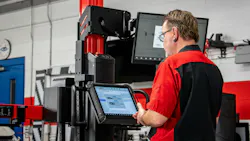
Are you walking away from extra revenue by not offering advanced driver assistance system (ADAS) calibrations after modifying customers’ vehicles?
“There are several opportunities for shops to expand services and increase revenue through ADAS-related work,” says Chuck Olsen, vice president of automotive technology solutions, AirPro Diagnostics. “Many tire dealers already perform services like tire pressure monitoring system (TPMS) work, tire size reprogramming and alignments. Adding ADAS calibration — particularly for forward-facing cameras and radar — is a natural next step. Changes such as tire size, wheel fitment, ride height adjustments and vehicle alignments can affect ADAS performance.
“Tire dealers and performance installers should strongly consider adding ADAS calibration services. When tire sizes, wheels, ride height or suspension components are changed, the vehicle’s speed calculations and sensor reference points can also change. At a minimum, TPMS service and tire size reprogramming should be performed so the vehicle has accurate wheel-speed data — an important input for ADAS systems.
“When tire size or ride height changes significantly, perception sensors such as forward-facing cameras and radar may also require recalibration so the system can correctly interpret its surroundings from the vehicle’s new stance. Addressing these changes helps ensure ADAS systems function properly and can significantly reduce liability exposure for the shop.
“ADAS is not a temporary trend. Advanced safety systems are expanding rapidly as automakers add new features and regulators introduce additional safety requirements, such as automatic emergency braking. Similar technologies — like TPMS, ABS and electronic stability control — were once considered new or optional, but are now standard across the industry.
“While there is an investment in training and equipment, there are multiple scalable options for shops to begin performing common calibrations, including forward-facing camera, radar and blind-spot radar systems. Dynamic calibrations performed during a road test can also be integrated into existing workflows.
“One of the most important best practices is conducting a pre-scan and visual inspection before starting any work. This helps detect existing faults or system issues that may need further diagnostics or repair before calibration."
Stew Peregrine, senior executive, Autel North America, says shops that are installing performance tires, custom wheels, lift kits or suspension components “are already performing services that can affect ADAS sensors. Changing ride height, altering wheel and tire combinations or performing alignments can all require recalibration so those safety systems function as designed.
“That creates a natural opportunity for shops to keep the work in-house. Instead of subletting the calibration, they can incorporate pre- and post-scans and ADAS calibration into the same service workflow. For performance tire dealers, it’s a logical extension of the work they already do and a way to capture additional revenue while ensuring the job is completed properly.
“ADAS is now part of the everyday service environment for modern vehicles. Procedures like alignments, suspension changes, and ride-height modifications can all affect how cameras and radar sensors operate.
“As more vehicles on the road are equipped with these systems, (ADAS) calibrations are becoming a routine step in completing the repair correctly. Shops that can perform diagnostics and calibration in-house can control the repair process, reduce cycle time and ensure the vehicle leaves the shop operating as intended. For tire dealers and performance installers, it’s a natural extension of services they already provide.
“Stop leaving alignment and ADAS money on the table. Look at what you’re already doing today and ask, ‘How much revenue walks out my door with every car I send down the road uncalibrated or unscanned?’"
Ryan Gerber, ADAS product specialist at Hunter Engineering Co., says HP/UHP tire dealers should seriously consider adding ADAS calibration to their service menu. “Customers interested in HP/UP tires also tend to place high value on properly servicing and maintaining their vehicles. One option is offering various ‘complete packages’ built on items like HP/UHP tires, plus custom wheel install, plus alignments, plus ADAS calibration to ensure (vehicle) safety and performance. Educate customers that modifications can affect ADAS and position calibrations.
“Ride height changes from lift/leveling kits, new springs or even larger tires shift sensor angles,” says Gerber. “Even a one-inch or a two-inch lift can throw off radar/camera alignment — leading to false alerts, missed detections or system faults.” ADAS calibrations “protect the customer’s investment and create a new revenue stream for tire dealers and installers.
“Investing in equipment and training always comes down to return on investment. Hunter Engineering offers numerous online tools to help customers choose equipment that best fits their scenarios. ADAS features — cameras, radars, sensors for lane-keeping, automatic emergency braking (AEB), adaptive cruise, etc. — are deeply embedded in modern vehicles and are only expanding, driven by safety regulations, consumer demand and manufacturer commitments.
“AEB became effectively standard on most new U.S. vehicles through industry agreements and federal rules require it on all new passenger cars and light trucks by model year 2029,” Gerber continues. “Recent legislation, such as the ADAS Functionality & Integrity Act, directs the National Highway Traffic Safety Administration to set calibration guidelines for new vehicles starting in model year 2028, ensuring systems stay functional post-repair or modification.”
Alignments present a great opportunity for transitioning to ADAS calibration, says Michael Czorny, marketing manager, Launch Tech USA. “With a lift kit, you are likely performing a wheel alignment, as well. That is where you trigger a need for front camera calibration, as well as radar. Ford allows for input on ride height adjustments, which our Launch scanners are capable of performing.
“Tire dealers and installers should consider adding ADAS to their service. This is because most manufacturers advise doing radar and lane departure after something as simple as wheel alignment. Changing the wheel alignment, ride height, tire and wheel size can all have an adverse effect on the performance of these systems. Performing ADAS calibrations will ensure the proper functionality of these systems, giving both the installers and customers peace of mind that their safety systems will operate correctly in the event they are needed.
“Seeing the perceived cost of entering the ADAS space and being reluctant" to invest in calibration equipment "is understandable. Although once you have the equipment, the income opportunity is high and can offset the cost of entry and become a very profitable side of the service. Most customers who are getting these types of modifications to their vehicle would be a possible ADAS upsell on the service. Ride height change offers the opportunity to calibrate all ADAS systems on a vehicle. While wheel alignment and tire/wheel changes offer the opportunity for radar and lane departure calibrations.
“It is highly unlikely that any manufacturer is going to remove these systems from their vehicle lineups. ADAS has only become more common over the past few years. These systems are responsible for the prevention of accidents and driver safety. These systems are also a big selling point for many manufacturers. There is also a requirement from the government that expressly states that an ADAS safety system must be installed on every new vehicle.”
Denis White, who manages TEXA USA’s education program in North America, says ADAS calibrations “are driven by doing a wheel alignment on a car. If you’re putting $5,000 worth of tires and wheels or more on a car, you’re likely to go ahead and pay for a wheel alignment.”
Many vehicle manufacturers “ask you to calibrate the ADAS features. So (when) you get done with an alignment, you’re going to do steering angle sensors ... and then you're going to calibrate the items that are relevant to ADAS, (like) forward radar and forward camera. Those are several hundred dollars per calibration in addition to the wheel alignment. Some of those are static. Some are dynamic. But the fact (tire dealers) are doing alignments is what drives them to have to do ADAS.
Other modifications to a vehicle can present challenges and considerations, he adds. “Significantly lowering a vehicle or significantly raising a vehicle beyond normal operation is something that can affect the functionality of ADAS. The Ford F-250 allows for different fender heights to be entered in and allows for calibration. GM doesn’t allow for significant changes to suspension height.
"The argument for dealers that are modifying vehicles from the factory has been, ‘What can we do to stay within OEM specifications and what can’t we do?’ SEMA and other entities out there are doing diligence on this idea and there is actually legislation out there about doing modifications on vehicles. I’m a fan of modifying vehicles. But at the end of the day, you also have to keep them safe.”
Vehicles equipped with ADAS are here to stay, says White. “We aren’t going away (from ADAS). We’re going toward it. (Dealers) can get into forward calibrations cheaper than they can buy a tire machine today. Training technicians is not expensive. The ROI on ADAS has been the best I’ve ever seen of any equipment in a shop. It is amazing. I certainly would encourage everyone to have a better understanding of this.”
Tire dealers "can also partner with glass repair shops, nearby general service shops or collision repair shops to provide ADAS services and add to your revenue stream,” says Eric Wuchte, product manager, ADAS calibration solutions, Bosch Mobility Aftermarket.
“Nearly 100% of vehicles produced today have at least one notable ADAS system. Our estimate of the total U.S. fleets — vehicles now on the road — is that roughly 60% to 70% contain at least one ADAS system. The bottom line for all this is literally your bottom line. Wheel service plus alignment and ADAS will keep your business competitive with new profit centers.”
About the Author

Mike Manges
Editor
Mike Manges is Modern Tire Dealer’s editor. A 29-year tire industry veteran, he is a three-time International Automotive Media Association Award winner, holds a Gold Award from the Association of Automotive Publication Editors and was named a finalist for the Jesse H. Neal Award, the Pulitzer Prize of business-to-business media, in 2024 and 2026. A past Endeavor Business Media Editor of the Year, Mike has traveled the world in pursuit of stories that will help independent tire dealers move their businesses forward. Before rejoining MTD in 2019, he held corporate communications positions at two Fortune 500 companies and served as MTD’s senior editor from 2000 to 2010.