Secrets of Mounting, Balancing Large Tire/Wheel Assemblies
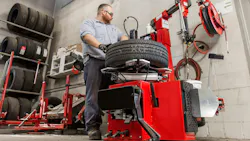
The size and weight of high performance (HP)/ultra-high performance (UHP) tire and wheel assemblies present unique challenges when mounting and balancing. Doing the job right requires skill, expertise, the correct equipment — and a little bit of patience.
“Modern tire changers and wheel balancers can be equipped with a wide range of standard features and optional accessories that make accurately mounting and balancing even the biggest wheels easier, faster and more efficient, but only if you use them correctly,” says Sean Price, director of quality control and product development at BendPak Inc.
“The most common mistake I’ve seen is techs who use improper technique and try to force the tire manually. This can damage the rim. Some also try to go too fast, skipping even basic steps like using lubricant or paste when mounting a tire. On a related note, the most common mistakes shops make are not training their technicians on the most efficient techniques and how to use all the features of their machines to stay safe and productive on the job. Every tech should be thoroughly trained on every piece of equipment they’re expected to use.”
When working with expensive, high-end rims, “don’t ignore wheel protection,” says Price. “Not using tire lubricant or paste is asking for trouble and will lead to a damaged wheel. There’s also the issue of an improper clamping technique. When mounting a tire, don’t clamp the wheel internally. This will scratch the powder coat. Always externally clamp to protect the finish.
“Have the proper equipment and set-up for larger tire and wheel assemblies,” he continues. “The stiff sidewalls and size of these tires require power assist arms to do the job right. Make sure everyone is trained on the equipment. Otherwise, (your) shop is losing productivity.”
“Proper centering is critical when balancing,” says Greg Meyer, senior product manager, wheel balancers, for Hunter Engineering Co. “Make sure you’re always using well-maintained, low-taper centering adaptors. Make sure you use a lifting device, like a wheel lift, to ensure (you) aren’t at risk of injury.”
Meyer says the most common HP/UHP tire and wheel package balancing mistake techs make is “poor centering from improper adaptors or adaptors used incorrectly. Low-taper collets are the best choice and should be used from the back — not from the outside or front coning. Cones and collets are often used well past their useful lifetime, which affects centering performance. Using low-taper mounting adaptors for large assemblies is the most common mistake on balancers.
When changing an HP/UHP tire and wheel assembly, haste makes waste, according to Jim Hudson, product manager, tire changers, Hunter. “The best practice is to simply slow down a little, for the sake of your own back and to prevent tire and wheel damage. This includes using the wheel lift, if present.
“A common mistake is just underestimating how heavy the tires and wheels actually are. It’s much more difficult to get those tires positioned for mounting and demount, especially without assist devices on the tire changer.”
Hudson also advises techs not to try to change a tire on a reverse wheel that’s improperly clamped.
“Mounting and balancing large-diameter assemblies requires a higher level of precision than standard fitments,” says Scott Reinholt, national director of sales and business development, garage equipment division, CEMB USA. “The increased mass and shorter sidewalls make these assemblies far more sensitive to minor errors, which can lead to vibration, comeback complaints or expensive wheel damage.”
Here are several things to look out for, he adds:
Use high-point/low-point match mounting. “Align the yellow mark on the tire — the lightest point — with the valve stem or the red mark — radial force variation — with the low point of the rim. Large tires often have significant ‘heavy spots.’ By matching these against the rim’s characteristics, you reduce the total amount of lead or zinc (wheel) weight needed. This results in a cleaner-looking wheel and a more stable balance.”
Prioritize back cone mounting. Reinholt says techs should always mount the wheel on the balancer using a cone from the backside of the hub bore instead of the front. “The backside of the wheel’s center hole is the machined surface that actually mates with the vehicle’s hub. Mounting from the front can lead to off-center errors because the front face of the wheel is often aesthetic and less precisely machined.”
Apply proper lubrication — and lots of it. “Use a high-quality, rim-grade lubricant on both the tire beads and rim seats. Avoid ‘bead-shrooms’ or soapy water that can cause a tire to slip on the rim after the customer leaves. Large-rim diameters have extremely stiff beads. Proper lube allows the bead to slide over the hump without tearing the rubber or damaging the tire pressure monitoring system sensor. It also ensures the tire seats fully at lower pressures, preventing a false balance.”
Perform a centering check. “After mounting the wheel on the balancer and tightening the wing nut, give the wheel a slow manual spin,” says Reinholt. “If you see any wobble or vertical movement, loosen and re-clamp.”
Account for static versus dynamic imbalance. “Always use a dynamic (two-plane) balance. For wide wheels, ensure you’re placing weights as far as possible — one row behind the spokes, one on the inner lip.”
The most expensive error a tech can make is improperly centering on the balancer, he says. “Technicians often fail to use a flange plate (lug-centric mounting) and instead rely solely on a standard cone (hub-centric mounting) for these heavy, large-diameter wheels. Why is this a critical error? It comes down to weight. A 22-inch wheel and tire assembly is heavy. When a technician slides that mass onto the balancer shaft using only a cone, the assembly often sags or sits slightly tilted. This results in a false center.
“Many large aftermarket and light truck wheels are lug-centric — meaning they are centered on the vehicle by the studs, not the hub bore. The center hole on these wheels is often not perfectly concentric to the lug holes. Consequently, if the wheel isn’t centered perfectly ... the balancer will tell the tech to add weight. After adding it, the next spin will ask for more weight in a different spot. ‘Chasing the weights’ is almost always a centering issue — not a tire issue.
“To do it right, a tech should just use a flange plate, which mimics the vehicle’s lug pattern, in conjunction with a back cone. The flange plate applies even pressure across the lug holes, pulling the wheel flat against the backing plate,” thereby preventing the wheel from slipping or vibrating during high-speed spins.”
The biggest “do” when mounting large-diameter tire and wheel assemblies is “using proper tooling and precision collets or hub-specific pilot discs in combination with a pin plate and maybe a wheel lift,” says Zach Christman, training specialist, North American equipment, Snap-on. “The reason for this is the machined center of the wheel and the weight of the assemblies. Indexing the wheel on the same radial axis as if it were on the vehicle is a critical step. The accuracy variables that show up in mounting discrepancy here grow exponentially with weight and assembly size.
“One of the most critical ‘don’ts’ is using a cone to balance a large-diameter hub bore, especially on a heavier assembly such as a dually wheel or large truck tire. The weight of the assembly is just simply not going to cooperate during the clamping process.”
About the Author
 Mike Manges
Mike Manges
Editor
Mike Manges is Modern Tire Dealer’s editor. A 29-year tire industry veteran, he is a three-time International Automotive Media Association Award winner, holds a Gold Award from the Association of Automotive Publication Editors and was named a finalist for the Jesse H. Neal Award, the Pulitzer Prize of business-to-business media, in 2024 and 2026. A past Endeavor Business Media Editor of the Year, Mike has traveled the world in pursuit of stories that will help independent tire dealers move their businesses forward. Before rejoining MTD in 2019, he held corporate communications positions at two Fortune 500 companies and served as MTD’s senior editor from 2000 to 2010.