Key Highlights
- High-performance modifications can pose safety risks if not performed within manufacturer guidelines, making expert judgment essential.
- Saying no to unsafe modifications is a key part of delivering a superior customer experience and maintaining industry integrity.
- Proper training and knowledge help technicians navigate customer requests while safeguarding vehicle safety and legal compliance.
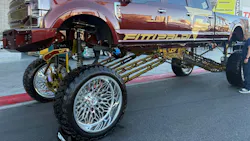
When I was thinking about a topic for this editorial, two old sayings came to mind: “Just because you can do something doesn’t mean you should do it” and the arguably more famous maxim, “The customer is always right.”
While I believe the former statement is true, the latter declaration — especially in the world of high performance (HP) tire/wheel installation and other vehicle modifications — is most definitely not true. Why is this distinction important?
Think back to the last time a customer asked you to perform a vehicle modification that would have rendered their car, SUV or pickup truck unsafe to drive — putting not only themselves and their passengers but also other motorists in harm’s way.
It could have been a plus-size tire and wheel package request that violated the “3% rule,” which is designed to guarantee that installed replacement tires are within 3% of the tire size shown on the vehicle’s placard.
It could have been a request to install a lift kit that fell outside manufacturer-recommended guidelines and procedures.
It could have been a stated reluctance or outright refusal to pay for whatever parts and service are required to ensure that their vehicle’s tire pressure monitoring system remained operational following the installation of a shiny new set of HP tires and custom wheels.
You can probably think of many more scenarios in which doing what the customer wanted turned out to be the wrong thing to do.
In the 2026 edition of the Performance Handbook, we feature five HP and custom wheel dealers who receive vehicle modification requests all the time. We call these dealers the “heroes of high performance” — not only because of their technical expertise but also because of how they do business.
One of them is Michael Spencer, co-owner of TireSouth Inc., which has six stores in the Atlanta, Ga., area.
What happens when a TireSouth customer asks for an unsafe — or just unwise — modification? “We try to steer them back to something that is backstopped by safety and at the end of the day, something that’s more drivable,” Spencer recently told me.
While customer satisfaction is important, “we have to do things the right way versus being dictated to by what the customer comes in and asks for. Customers come in with ideas. Sometimes they’re good and sometimes they’re not. If the customer wants you to do something that isn’t in their best interest or anyone’s best interest, that can put you in a predicament.
“We can’t take on liability for putting something on (a customer’s vehicle) that’s going to negatively impact the way that vehicle performs, just because a customer asked for it,” says Spencer, adding that “our job is to make sure customers end up in the right products and have the right fitments” that are appropriate for their vehicles.
Safety is a big part of TireSouth’s sales training. “You have to steer (customers) back to ‘the good’” or, in the case of some requests, reality.
The risk associated with doing otherwise is just too great, according to Kevin Rohlwing, chief technical officer at the Tire Industry Association, who contributed an article titled “10 Tips When Installing Performance Tire/Wheel Packages” for this year's edition of Performance Handbook.
In his story, Rohlwing discusses the potential performance, safety and yes, legal ramifications of installing tire and wheel packages — and making other vehicle modifications — the wrong way.
I encourage you to share Rohlwing’s article with your entire team. It may come in handy when talking with customers, too.
One theme expressed by all our heroes of high performance is their desire to create a great experience for their customers. This is what keeps their clients coming back. A big part of delivering a superior customer experience is doing what’s in the best interest of the customer. And sometimes the customer isn’t always right. It’s OK to say no.
Questions? Comments? Feel free to email me at [email protected].
About the Author

Mike Manges
Editor
Mike Manges is Modern Tire Dealer’s editor. A 29-year tire industry veteran, he is a three-time International Automotive Media Association Award winner, holds a Gold Award from the Association of Automotive Publication Editors and was named a finalist for the Jesse H. Neal Award, the Pulitzer Prize of business-to-business media, in 2024 and 2026. A past Endeavor Business Media Editor of the Year, Mike has traveled the world in pursuit of stories that will help independent tire dealers move their businesses forward. Before rejoining MTD in 2019, he held corporate communications positions at two Fortune 500 companies and served as MTD’s senior editor from 2000 to 2010.