Key Highlights
- The settlement requires Deere to provide independent repair providers with the same electronic repair tools and resources as authorized dealers for the next 10 years.
- The agreement is viewed as a significant victory for the Right to Repair movement, with potential implications for other industries such as automotive and tire services.
- The Tire Industry Association supports the Deere settlement as a positive step toward broader access to repair information and tools for independent tire dealers,
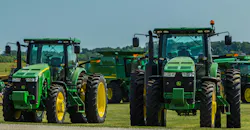
A recent settlement secured by the Federal Trade Commission (FTC) and the states of Illinois, Arizona, Michigan, Minnesota and Wisconsin with the world’s largest agricultural equipment supplier could be a sign of good things to come in the Right to Repair battle that has been waged in our industry over the last several decades.
I say “could” because it’s too early to tell.
The FTC settlement mentioned above requires farm equipment manufacturer Deere & Co. — you might know the company as John Deere — “to provide farmers and independent repair providers with the same equipment repair resources, including applicable software capabilities, that it currently provides to authorized Deere dealers” for the next 10 years, under the supervision of the commission and plaintiff states, according to a July 8 statement from the FTC.
The FTC alleged that Deere “used unlawful practices to limit the ability of farmers and independent repair providers to perform repairs on Deere farm equipment. Deere makes the only software repair tools capable of performing all electronic repairs on Deere equipment.
“Deere, however, had previously made such tools available only to its authorized dealers, forcing farmers to rely on authorized dealers for many necessary repairs. By withholding these repair capabilities, the complaint alleged Deere unlawfully acquired and maintained monopoly power in markets for repair services for Deere farm equipment. Deere’s practices led to service delays and higher costs for farmers, the complaint further alleged.”
The FTC statement goes on to say that under the terms of the order settling the lawsuit, Deere will be required to make available to farmers and independent repair providers, "on fair and reasonable terms, repair resources equivalent to those Deere now makes available to Deere dealers, including reading, clearing and resetting electronic fault codes; reprogramming of electronic components, including ‘pairing’ newly installed electronic parts with equipment; restarting a machine following an emissions-related shutdown, commonly referred to as a ‘limp mode,’ and viewing and searching technical manuals, troubleshooting solutions ... and other guidance and information useful for equipment diagnosis, maintenance, repair or upgrade.”
In addition, Deere will be forced “to make available to farmers and independent repair providers any future repair resources that are similar or reasonably necessary for repairs, once Deere makes them available to over 50% of its authorized dealer network in the U.S.; instruct its authorized dealers to promote the availability of these repair resources and support their use and not to discriminate or retaliate against any farmers or independent repair providers who purchase or use such resources rather than dealer repair services, and provide notice to the public, to Deere’s farmer and independent repair provider customers and to its authorized dealers information about the stipulated order and the availability of Deer’s repair resources.”
You might be wondering what falls under the umbrella of “repair resources.” The court filing says “repair resources” include the secure authentication of software tool user credentials; the viewing of operator and technical manuals; the viewing of diagnostic trouble codes and related diagnostic information; the clearing and refreshing of diagnostic trouble codes; the performance of interactive tests to confirm diagnostic or repair success; the disabling and resetting any electronic lock, immobilizer or security-related function to permit diagnosis, maintenance or repair, and a host of many other things.
As part of the settlement, Deere will be subject to “strict reporting and oversight requirements to ensure its compliance.” The order may even be extended beyond its original 10-year duration “if Deere violates its terms.”
It goes without saying the settlement is a big win for independent farm equipment dealers and repair providers and a good deal for John Deere equipment owners who now have the ability to take their machines elsewhere for fixes and maintenance.
But what does it potentially mean for Right to Repair in the tire and auto service industry?
The Tire Industry Association (TIA) calls the Deere settlement “an encouraging development for the broader Right to Repair movement. While the agreement focuses on agricultural equipment, it reinforces the growing recognition that equipment owners and the independent businesses that service them should have fair access to the tools, information and resources necessary to diagnose, maintain and repair modern equipment.
“TIA has long supported a comprehensive approach to Right to Repair that includes both agricultural equipment and motor vehicles. In 2026, TIA introduced Right to Repair legislation in Maryland that would have provided independent repair facilities with access to the information needed to service both farm equipment and automobiles. Although that legislation did not advance this session, we are pleased to see meaningful progress being made for agricultural equipment owners.
“The John Deere settlement demonstrates that practical solutions can be achieved while preserving safety, security and innovation. TIA believes this momentum should extend beyond the agricultural sector and serve as a catalyst for advancing Right to Repair policies for passenger vehicles and other equipment.”
Those of us here at MTD agree. Let’s hope the FTC-Deere settlement opens the door to substantive Right to Repair progress that will benefit you, the independent tire dealer, and your customers.
Questions? Comments? Email me at [email protected].
About the Author
 Mike Manges
Mike Manges
Editor
Mike Manges is Modern Tire Dealer’s editor. A 29-year tire industry veteran, he is a three-time International Automotive Media Association Award winner, holds a Gold Award from the Association of Automotive Publication Editors and was named a finalist for the Jesse H. Neal Award, the Pulitzer Prize of business-to-business media, in 2024 and 2026. A past Endeavor Business Media Editor of the Year, Mike has traveled the world in pursuit of stories that will help independent tire dealers move their businesses forward. Before rejoining MTD in 2019, he held corporate communications positions at two Fortune 500 companies and served as MTD’s senior editor from 2000 to 2010.