MTD Mid-Year Q&A: BKT Invests in Distributors, Dealers
Key Highlights
- BKT quickly adapted its logistics and operational strategies to mitigate tariff impacts and supply chain disruptions in 2026.
- BKT's five-year strategic plan remains on track, aiming for increased market share in off-highway segments.
- The company's Bhuj plant in India continues to expand capacity, supporting BKT's global growth with new product lines and increased self-sufficiency.
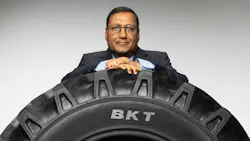
BKT is dedicating significant efforts to help benefit its distributors and dealers, Arvind Poddar, the company's chairman and managing director, tells MTD in this exclusive interview.
MTD: Can you provide us with an update on BKT’s performance in the U.S. so far in 2026? What have been some of the company’s challenges and achievements?
Poddar: The first few months of 2026 presented a complex landscape for the entire industry. Geopolitical uncertainty, volatility in import tariffs, pressures on raw material and logistics costs and supply chain challenges influenced distributors’ purchasing decisions and inventory management. In this context, BKT quickly adapted its logistics and operational strategy, working closely with partners to manage the impact of tariffs and ensure continuity and reliability in supply. BKT also continued to strengthen its product portfolio and the support offered to distributors and dealers. To date, the gradual easing of tariff pressures has helped improve channel confidence, fostering a gradual recovery in orders and bringing inventory levels back to a more balanced state.
BKT USA has also implemented initiatives to incentivize American dealers, introducing the BKT EDGE Associate Dealer Program - more benefits, tools, and support designed to promote dealer activity and loyalty.
These strategic decisions and the company’s strong ability to adapt have enabled it to maintain a solid foothold in the U.S. market, with the agricultural sector driving BKT USA’s sales performance in the first half of 2026. These results underscore BKT’s multinational resilience, achieved through well-considered actions aimed at maintaining market strength and steady growth.
MTD: What is your assessment of the state of replacement ag and OTR tire demand in the U.S.? What trends are you seeing?
Poddar: In the first few months of 2026, demand for replacement tires in the agricultural and OTR sectors in the United States was slightly lower than we had expected. Uncertainty surrounding tariffs, pressure on operating costs and geopolitical tensions have led to more cautious purchasing decisions. In some parts of the country, severe weather events also temporarily slowed down operations and demand.
The landscape remains mixed. However, in the agricultural sector, many operators are using existing tractors and machinery for longer periods, postponing the purchase of new equipment. This trend may support replacement demand, as keeping machinery in service requires greater attention to maintenance and tire replacement.
Despite a generally slow start to the year, market sentiment remains broadly positive, with distributors and dealers looking ahead to the second half of the year with confidence and most are expecting to close out 2026 with sales results exceeding the previous year.
Among the key trends currently shaping the U.S. agricultural and OTR sectors is a growing focus on inventory management, driven by the need to mitigate the effects of supply chain delays. Another key aspect involves optimizing procurement by prioritizing value-driven purchasing decisions that ensure product availability and maintain balanced inventory levels. In a general climate of uncertainty and intense cost pressure, it is essential to focus on supply continuity and the overall value of the offering - factors that are increasingly decisive in customer decisions.
MTD: When we spoke last summer, you mentioned that BKT had presented its new five-year strategic plan, which sets the company’s goal of reaching approximately $2.6 billion in total revenue by 2030. Is the five-year plan unfolding as intended?
Poddar: In 2025, the group unveiled its five-year growth plan through 2030, which included entry into strategic markets and the establishment of ambitious long-term goals, such as achieving $2.6 billion in revenue. A fundamental pillar of the corporate vision is strengthening BKT’s leadership in the off-highway tire industry and entering new product categories. Despite the overall economic landscape, the corporate goals remain unchanged and ambitious, with a growth strategy aimed at achieving a 10% global market share in the off-highway sector.
The company’s commitment to achieving these results is reflected in a winning combination of market diversification (and) increasingly innovative cutting-edge products, as well as vertical integration. At the same time, BKT remains committed to maintaining its resilience and adaptability in a constantly evolving market to deliver value to its customers globally.
MTD: BKT entered the on-highway tire business in India earlier this year. How has that effort progressed? Do you have plans to export any of those product lines to North America in the near term?
Poddar: In February 2026, the group announced a strategic entry into the consumer tire market with a product range for two-wheeled vehicles, paving the way for an upcoming entry into the on-highway commercial segment. This decision is part of BKT’s 2030 Growth Plan ... which has received an initial positive and encouraging response during the early launch phases. In the short term, which includes the current year, the priority is to position the BKT brand in the consumer market and to raise brand awareness to develop the distribution network and gain market share in India. Once we have achieved greater production and commercial scale, the expansion of this new business area into other international markets - such as North America or Europe - will be a natural progression of the direction we have taken, as well as the result of a carefully crafted strategy.
MTD: Shifting to manufacturing, last year you mentioned that BKT is focused on "optimizing existing facilities, boosting manufacturing performance and supporting the introduction of new product lines." Can you update us on the progress that’s been made in those areas, particularly as they pertain to BKT's plant in Bhuj, India?
Poddar: Over the past year, we have translated these priorities into concrete industrial initiatives. The Bhuj plant continues to play a central role in BKT’s production strategy, both in optimizing existing operations and in developing new capacities and product categories. One of the most significant developments concerns carbon black. We have completed a new production line, bringing installed capacity to 265,000 metric tons per year. The next phase of the expansion will bring total capacity to 360,000 metric tons per year and is expected to be operational in the first quarter of fiscal year 2027.
The project also includes a new 24 MW (megawatt) cogeneration plant, which will bring Bhuj’s total cogeneration capacity to 64 MW. This greater integration between carbon black production, power generation and tire manufacturing strengthens control over strategic resources and supports more efficient and reliable management of operations.
Regarding off-highway tires, the current expansion program and debottlenecking activities will take total production capacity to new levels. At the same time, in Bhuj, we are developing capacity for rubber tracks, radial truck tires for commercial vehicles and progressively, passenger car and light truck radial tires.
Bhuj is therefore not merely our main production hub. It is an integrated industrial platform that allows us to increase capacity, introduce new product lines and support BKT’s future growth with greater efficiency and operational continuity.
MTD: Is the Bhuj plant the primary source of BKT products for the U.S. market?
Poddar: Bhuj is BKT’s flagship location and serves as the company’s primary production facility and supply hub that serves international markets, including the United States. Over the years, the Bhuj site has undergone significant evolution. Inaugurated in 2015, it is now the primary production hub of Balkrishna Industries Ltd., with an annexed research and development center, testing facility and carbon black production plant.
The site has been continuously renovated, expanded and extended to support increased production capacity in line with the company’s growth objectives, thereby establishing itself as one of the largest and most important facilities globally dedicated to the production of off-highway tires. Bhuj is the result of multiple targeted investments, including the vertical integration of carbon black production. Further investments are underway with the aim of increasing production capacity even further and moving toward full self-sufficiency as a strategic medium-term goal.
BKT has transformed Bhuj into a highly strategic and technologically advanced production and R&D hub that is essential for supporting the company’s future growth in the off-highway tire segment and more recently, in the consumer and two-wheeler segments, as well.
MTD: In the U.S., BKT’s primary business-to-consumer marketing investment over the past several years has been its sponsorship of Monster Jam. How has this paid dividends for the company and its dealers?
Poddar: The partnership with Monster Jam has generated value for BKT on multiple levels. Launched in 2014 and recently extended through 2031, it has ensured the brand a continuous and highly visible presence at one of the most recognizable motorsports events in the United States, helping to increase BKT’s brand awareness among a much broader audience than that traditionally associated with off-highway tires.
Monster Jam also allows the brand to be associated with instantly recognizable concepts such as ruggedness, reliability, innovation and performance in extreme conditions. The tires used in the competition are specifically developed by BKT in collaboration with Feld Motor Sports. Over the course of the partnership, four generations of products have been created and continuously improved based on testing, track experience and driver feedback.
For BKT, this partnership serves both as a communication platform and as a concrete demonstration of our design and development capabilities. It allows us to showcase the brand in action - in a context where tire performance is visible and easily understood even by a non-technical audience.
The value of the partnership also extends to our dealers. Monster Jam makes the BKT brand more familiar to customers even before they enter a retail location. It also provides dealers with content, initiatives and experiences through which they can engage local communities, build relationships and strengthen trust in the brand. In this sense, Monster Jam helps create a link between consumer visibility and commercial activity. Dealers can introduce a BKT product by starting with a brand that the customer has already seen in an engaging, highly recognizable context. This facilitates conversation, strengthens the credibility of the offering and supports the long-term relationship between BKT, its dealers and end users.
MTD: What can we expect to see from BKT USA during the remainder of 2026 and into next year?
Poddar: BKT USA is looking towards the near future - and specifically to the second half of the year - with optimism and a generally confident outlook, thanks to a series of strategic initiatives aimed at strengthening its growth and development objectives by leveraging long-term relationships with customers, distributors, and dealers.
In line with the group’s overall objectives, the company also continues to pursue its commitment to research and development into increasingly innovative and high-quality solutions specifically designed to meet the specific needs of the markets and sectors in which the company has operated for nearly 40 years. In fact, 2027 will also mark the 40th anniversary of Balkrishna Industries Ltd.’s founding - a further opportunity to reflect on the journey undertaken over these decades, looking towards the future with equal commitment.
As far as the American market is concerned, we will continue to dedicate significant efforts to benefit distributors and dealers. For example, through the expansion and progressive development of the BKT EDGE Associate Dealer program, we offer even more value to participants and to attract new ones. Furthermore, we will strive to adapt promptly to new market developments, continuing the path we have taken in product development, which is already one of the most extensive and comprehensive ones on the market. The goal remains to consolidate the brand’s presence across the various sectors in which it operates to better meet customer needs and to seize new market opportunities in line with our growth objectives and the strategic roadmap through 2030.
About the Author

Mike Manges
Editor
Mike Manges is Modern Tire Dealer’s editor. A 29-year tire industry veteran, he is a three-time International Automotive Media Association Award winner, holds a Gold Award from the Association of Automotive Publication Editors and was named a finalist for the Jesse H. Neal Award, the Pulitzer Prize of business-to-business media, in 2024 and 2026. A past Endeavor Business Media Editor of the Year, Mike has traveled the world in pursuit of stories that will help independent tire dealers move their businesses forward. Before rejoining MTD in 2019, he held corporate communications positions at two Fortune 500 companies and served as MTD’s senior editor from 2000 to 2010.