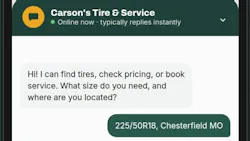
Interest in artificial intelligence among independent tire dealers is growing, says Carson Cornelius, general manager of Tireweb, in this MTD exclusive.
MTD: How early are we in the integration of AI into tire retailing?
Cornelius: We are still early in the adoption of AI across tire retail. Interest and experimentation are growing, but adoption varies widely by dealership and by use-case. Many dealers are not yet using AI to run core parts of their businesses. Instead, they are using it to assist with specific tasks.
Right now, we're seeing AI used in narrow, practical ways such as answering customer questions, capturing leads, summarizing information, generating marketing content and automating repetitive tasks. Those use cases are proving value today.
The bigger transformation is still ahead of us. Over the next several years, I expect AI to become more deeply embedded in phone systems, websites, scheduling, inventory management, customer communications, parts sourcing and service workflows. Dealerships that begin learning now should be better positioned to evaluate and apply the technology as it develops.
We are beyond the point of treating AI as a novelty, but early enough that dealers can learn through focused experiments before the technology becomes a standard part of retail operations.
MTD: Are more independent tire dealers embracing AI? Do you think there's been a reluctance to use AI on the part of some dealers?
Cornelius: I think it's important to distinguish between back-office AI and customer-facing AI.
On the back-office side, I think adoption is inevitable. Dealers are already using accounting platforms, marketing tools, CRMs and other software that are rapidly building AI into their products. Over time, many dealers will benefit from AI without necessarily seeking it out because it will become a standard feature of the systems they already rely on.
The customer-facing side is different and that's where I think independent tire dealers are moving more cautiously than automotive dealerships. In the automotive dealership channel, we're already seeing AI used for lead outreach, lead management, appointment scheduling and customer follow-up. Many dealerships are comfortable letting AI handle the first stages of customer interaction.
Independent tire dealers have traditionally built their businesses around personal relationships and local trust. Because of that, they're understandably more cautious about introducing AI into customer conversations. They want to know that the experience will be accurate, helpful and consistent with how they serve customers today.
That doesn't mean they're opposed to AI. It simply means they're looking for proven use cases with a clear return on investment before putting technology in front of their customers. Independents don’t often allocate their tight margins to big swings on unproven tech.
MTD: In what ways are your customers currently using AI?
Cornelius: The biggest area of interest Tireweb is seeing is customer communication. Tire dealers lose opportunities every day because they're busy helping customers in the store, working with technicians, handling other operational tasks or the shop is closed. Calls get missed. Chat messages go unanswered. Customers reach out after hours when nobody is available to respond.
That's where we're seeing AI create immediate value. AI phone agents and chat agents can engage customers when staff members aren't available, answer common questions, collect information and ensure opportunities aren't lost simply because the dealership couldn't respond quickly enough.
Another area we're particularly excited about is after-hours dispatch for service calls. It is difficult to staff overnight for fleet service calls. AI can capture critical details, route requests appropriately and make sure customers receive a response even when the shop is closed and most of your employees are asleep.
What I like about these use cases is that they're not replacing employees. They're helping dealerships extend their availability, improve responsiveness and create a better customer experience without increasing staffing requirements. For many dealers, AI's first job isn't selling tires. It's making sure no customer request falls through the cracks. I must admit, though, and we can tell from transcripts, not all customers are excited about talking to an AI agent yet.
MTD: What are some other practical applications of AI within independent tire dealerships? What tasks can AI help with?
Cornelius: The most practical applications are the repetitive tasks that eat up hours every day, in both the front office and the back office. A lot of people hear AI and picture something futuristic. It’s best at the predictable, repetitive work, and every tire shop has plenty of that.
Internally, AI can draft estimates, summarize service histories, prepare appointment reminders, flag incomplete customer records and organize information from phone calls and web inquiries. It can also help categorize incoming requests and spot inventory or workflow patterns worth a closer look. The best starting points are tasks that happen often, take real time and are easy for an employee to check before anything reaches a customer.
Marketing is another area where dealers can see value right away. AI can write website content, draft email campaigns and create social posts, helping a shop stay consistent without adding staff.
The key is pointing AI at a well-defined problem and keeping a person in the loop. Customers still come to a tire dealer for experienced people they trust to diagnose problems and give straight answers. AI can take on the routine work around those conversations, so your team has more time for them.
MTD: What's your advice to tire dealers who may be on the fence about integrating AI into their operations?
Cornelius: Don't try to transform your whole business at once. Pick one problem - like missed calls or after-hours inquiries - and try a tool against it for 60 days. Read the transcripts, check the results and decide based on what you see. Trust, but verify. The tire dealers who get comfortable with AI will be the ones who started small and learned what works in their own shop.
About the Author
 Mike Manges
Editor
Mike Manges is Modern Tire Dealer’s editor. A 29-year tire industry veteran, he is a three-time International Automotive Media Association Award winner, holds a Gold Award from the Association of Automotive Publication Editors and was named a finalist for the Jesse H. Neal Award, the Pulitzer Prize of business-to-business media, in 2024 and 2026. A past Endeavor Business Media Editor of the Year, Mike has traveled the world in pursuit of stories that will help independent tire dealers move their businesses forward. Before rejoining MTD in 2019, he held corporate communications positions at two Fortune 500 companies and served as MTD’s senior editor from 2000 to 2010.