AG Tire Talk: Tractor Tire Alignment and Performance
Key Highlights
- Misalignment in tractors is common and can lead to increased tire wear, poor steering, and reduced efficiency if not properly addressed.
- Proper tire alignment ensures better traction, fuel efficiency and overall tractor performance, especially after repairs or hitting obstacles.
- Following manufacturer specifications for alignment settings and performing periodic checks can significantly extend tire life and improve productivity.
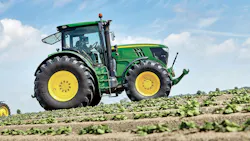
Questions: Is tractor misalignment a common issue? What tire problems can result from misalignment, and how can you help ensure proper tractor alignment?
Robert Bender, product manager and tech support, off-highway tires, Ascenso Tires North America: When we get new tires on our passenger car or pickup, it’s recommended to have a tire alignment performed for maximum tire life. It’s also recommended for the alignment to be checked periodically. This is no different from tractors.
Producers spend a significant amount of money on tires for their tractors. Those tires should be given the same chance at life as the tires on a pickup truck or car. Watching for irregular tire wear or unusual pull to one side or the other while driving the tractor can be a sign that there is an ag tire alignment problem.
Parallelism is the relationship of the tires to the centerline of the tractor when viewed from the top. It’s imperative that the tires are as close to perfect parallel to prevent premature tire wear from misalignment, as well as to help ensure proper steering performance. With bouncing through fields, over pivot ruts and higher road speeds, tractor steering components take a beating and so do the tires.
Checking parallelism can be done quite simply by using a tape measure or measuring rod and having a flat surface to park on — by marking the inner sidewall at the same height on both front tires and measuring across the front tires, then backing the tractor up until that mark is at the same height on the backside of the axle and measuring again. This will give the toe-in or toe-out measurement. It’s recommended to verify with the service manual for proper adjustment and specifications, but the general rule of thumb is no more than 1/8-inch toe-in.
It is equally important to check all front-end components for wear and tear, like tie rods, steering joints, cylinders and bearings. All these components, when worn, can contribute to misalignment, resulting in poor steering performance and excessive tire wear. Even being slightly out of alignment specification, tractor tire wear can increase 12% to 15% and in more extreme cases, up to 40%.
There are other tire alignment angles that can contribute to tractor performance and tire life, but can be more difficult to measure without specialized equipment and may not be as easily adjustable. Visual camber changes can indicate bent or excessively worn front axle components. Caster is the other alignment angle and is primarily a stability angle. Caster is the angle of the steering axis as if there were an imaginary line drawn through the upper and lower steering knuckle pivot points when viewed from the side. In most cases, it will not directly affect tire wear but will affect higher speed stability.
Dave Paulk, manager, field technical services, BKT USA Inc.: When it comes to front tire wear on agricultural tractors, alignment almost always comes down to one setting: toe, which is often called wheel parallelism. In real farm conditions, incorrect toe plus worn steering components are the most common cause of abnormal front tire wear. The good news is that toe can be checked quickly on-farm with simple tools and it’s one of the highest-return on investment maintenance actions for extending front tire life. Incorrect toe forces the tires to scrub sideways as they roll. This causes rapid shoulder wear, feathering (sawtooth wear on lugs), steering wander and in advanced cases, vibration due to uneven lug wear.
How do you check toe alignment? Measure using the rim/flange as the reference, not the tire. Tire-based measurements can be affected by mounting irregularities, runout, lug shape or bead seating. Here’s a step-by-step procedure:
-
Park on a flat, level surface;
-
Check front tire installation pressure;
-
Center the steering and on MWFF tractors, disengage 4WD;
-
At hub height, measure the distance between the two front wheels at the front of the tire, using rim/flange reference points;
-
Roll the tractor forward until those same reference points are now at the rear position and measure again;
-
Compare front distance smaller than the rear (toe-in) and rear distance smaller than the front (toe-out);
-
Adjust.
Toe is normally adjusted via the tie rods. After adjustment, recheck measurements and ensure steering is centered. What toe-in tolerance is acceptable? There is no universal toe spec. Toe requirements vary by tractor model, axle design, tire size and front load/ballast configuration.
Always follow the tractor OEM manual for the exact toe-in specification and tolerance. As a general principle, tractors typically require a small amount of toe-in, not toe-out.
Greg Gilland, vice president, global agriculture, Maxam Tire North America: Tire alignment is a crucial part of any powered machine. Specifically in the ag industry, tire alignment has a direct impact on two-wheel drive (2WD) tractors, mechanical front wheel drive (MFWD) or mechanical front wheel assist (MFWA) tractors, self-propelled sprayers and floaters. The key component is to ensure that the front tires are functioning as straight or as aligned as possible with their rear axle tires. Proper tire alignment ensures power is efficiently transmitted without affecting performance. Poor tire alignment causes irregular wear, poor service life and more.
When tires are perfectly aligned from front to rear, they are in-parallel. Although ag tires are off-the-road tires designed to operate in multi-surface field operations, ruts, row alignment, debris and other obstacles are common factors that may affect alignment, leading to poor or reduced performance. If the tires are not aligned, they could also suffer from another alignment condition, known as the camber effect. Below are some signs of a potential alignment issue:
-
When the vehicle is in forward motion, the end user experiences the front tires pulling left or right;
-
The end user is constantly correcting his steering because of the vehicle pulling to the left or to the right;
-
The end user experiences increased tire vibration as he accelerates due to the tread angles resisting the road;
-
When turning the vehicle in any direction, the end user experiences more resistance to the turn in question;
-
The end user notices increased tire wear or irregular wear on one side or on both sides of the tires;
-
In some instances, the end user experiences reduced traction in the field or reduced braking capability;
-
In extreme cases, the end user experiences increased fuel use due to loss of traction or more slip.
As with all machinery or vehicles, continuous maintenance will ensure improved tire performance and optimal tire life. Vehicle alignment will have a direct impact on tire life, fuel efficiency, handling performance and overall productivity.
David Graden, global account manager, agriculture, Michelin North America Inc.: When we think about tire performance, air pressure usually gets all the attention. But alignment? That’s just as critical and often overlooked. Alignment is all about how tires sit relative to each other and the machine. If they’re not set correctly, the end user will see uneven wear, reduced traction and even steering issues. For tractors, the most common culprit is toe setting, but camber and caster play a role, too.
Is misalignment common? Absolutely. It can happen after suspension repairs, hitting obstacles or even gradual wear of steering components. And because tractors operate under heavy loads and high torque, small errors in alignment can have big consequences.
Check alignment regularly, especially after tire changes or suspension work. Use proper tools or consult your dealer for precision adjustments. Correct alignment doesn’t just save tires. It improves traction, fuel efficiency, machine stability and overall efficiency/productivity.
Chris Neidert, ag marketing, training and development manager for Trelleborg and Mitas Tires, North America, Yokohama TWS: Your customer spends thousands of dollars on a new set of tires — front and rear. He roads the tractor approximately 60% to 75% of the time and after a few hundred hours or sooner, starts to notice irregular tire wear on the fronts. Many growers will immediately blame the tire as the cause. We get these calls all the time. Let’s look at what is probably the culprit — and that is your equipment’s tire alignment.
Our discussion will center on tractors. Tractors can be out of alignment, very much like your passenger car or your light truck or over-the-highway trucks. Let’s start by looking at toe. If the front of the tires points slightly inwards, which is referred to as toe-in, there will be wear to the outside of the tires. The opposite will happen if the front of the tires points outwards, which is referred to as toe-out. In this case, there will be wear to the inside of the tires. In both cases, an adjustment is necessary to reduce wear.
For ag tires, the acceptable toe-in measurement is typically very small — often 0 to 1/8 inch of total toe-in, with some sources recommending 1/16-inch as ideal to ensure proper steering and minimize tire wear, though slight variations exist for 2WD versus 4WD tractors, with 4WD sometimes allowing slight toe-out. Always check the specific tractor’s manual, as manufacturers provide precise specs, but the general goal is to keep the front of the tires closer together than the rear for stability.
Camber can also affect tire wear. Camber is the inward or outward tilt of a wheel when viewed from the front of the vehicle, measured as the angle between the tire’s vertical axis and the road. Positive camber means the top tilts outward. Negative camber means the top tilts inward, like on racecars. Zero camber means the wheel is perfectly vertical. This alignment affects handling, grip and tire wear, and it maximizes the tire’s contact patch with the ground. We all know what the correct contact patch with the ground can do.
Checking your vehicle's alignment will go a long way in solving tire wear problems.