Key Highlights
- GDI engines can accumulate deposits that interfere with injector spray patterns and contribute to misfires, reduced fuel economy, emissions and power loss.
- Technicians should use trouble codes, fuel trims, misfire data, pressure tests and other diagnostics to guide service recommendations.
- Cleaning cannot fix mechanical or electrical injector failures, so inspection and post-service verification are essential.
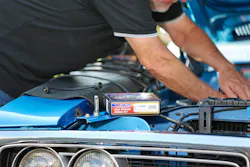
As gasoline direct injection (GDI) engines become the dominant engine technology and fuel costs keep rising, fuel injection system maintenance has never been more important.
"Gasoline direct injection engines have created really great things," says Matt Shaw, vice president of sales, Mighty Auto Parts. "It's great for fuel economy, more horsepower and more torque in vehicles. The downside is it creates very high engine pressure, very hot temperatures and takes away some of the cleaning ability inside the engine with fuel."
Without consistent fuel injection system maintenance to clean carbon deposits, carbon accumulates gradually over thousands of miles and most drivers rarely notice lost fuel economy or sluggish power.
"Over time, heat, pressure and variations in oil contamination and fuel quality cause carbon deposits, varnish and olefin wax to build up on the injector nozzles and even a microscopic layer of carbon can disrupt the fuel spray pattern, preventing proper atomization," says Alan Ferry, True Brand technical director.
"When fuel doesn't atomize correctly, the engine struggles with an improper air-fuel mixture, leading to misfires, reduced fuel economy, increased tailpipe emissions and lost power."
As GDI engines and their cleaning issues become the new norm, fuel injection system maintenance is vital. This service isn't another performance upsell. It's preventive maintenance that improves profits and builds customer trust.
Evolving engine technology
Experts say fuel injection system maintenance is no longer just pouring in fuel cleaner and calling it a day. GDI engines, new fuel standards, hybrid engines and the shift to diagnostic-led maintenance are all changing today's approach to fuel injection maintenance.
"Ultimately, good fuel injection maintenance is not about selling a cleaner," says Greg Brock, field training manager, Walker Products. "It's about preserving accurate fuel delivery, protecting downstream emissions components and using diagnostic data to make the correct repair the first time."
"Because GDI bypasses the intake valves, shops must perform dedicated induction cleaning services using aerosols or specialized liquid misters fed directly into the air intake," adds True Brands' Ferry. "Standard fuel tank additives alone are no longer sufficient to prevent the severe carbon buildup that plagues modern GDI engines."
Fuel performance standards are also changing to help remove these harmful carbon deposits. From late 2025 through 2026, the industry has been transitioning from the classic Top Tier Approved Gasoline standard to the enhanced Top Tier+ Approved Gasoline standard.
Ferry says the updated standard "implements three new engine detergency tests. While this helps keep injector nozzles cleaner, shops must educate their customers that this enhanced fuel still completely bypasses intake valves in GDI engines. Professional chemical induction services remain absolutely critical to prevent valve coking."
Hybrid vehicles also present unique challenges because internal combustion engines cycle on and off continuously. "This prevents the engine from consistently reaching the optimal operating temperatures needed to burn off carbon naturally, thereby accelerating deposit formation," says Ferry.
As a result, fuel sits in the tank much longer in hybrids, increasing the risk of fuel degradation. "Shops should treat hybrid vehicles proactively with advanced fuel stabilizers and robust cleaning agents formulated for lower-temperature operating cycles," adds Ferry.
Diagnostic-led
Like many services, fuel and induction system maintenance has also shifted to a highly diagnostic service.
True Brand's Ferry points out that shops are increasingly relying on advanced scan data to monitor long-term fuel trim (LTFT) and misfire counters. This lets technicians pinpoint spray-pattern disruptions and prove the need for targeted chemical cleaning before the check engine light comes on.
Walker Products' Brock also emphasizes that a complete fuel injection system maintenance service should begin with an inspection and diagnostic evaluation, rather than automatically applying cleaning products.
"A practical first step is to review trouble codes, fuel trims, misfire data and visible system condition during a routine inspection. If those findings indicate an imbalance, pressure concern, deposit issue, or leakage problem, the shop can recommend more focused testing or service. This approach makes the recommendation easier to explain to the customer because it is supported by vehicle data rather than a generic mileage-based sales message."
Depending on the vehicle and its symptoms, Brock recommends that shops consider the following:
- Scanning for active, pending, and historical diagnostic trouble codes (DTCs);
- Analyzing short-term fuel trim (STFT) and LTFT values;
- Evaluating upstream and downstream oxygen sensor response patterns;
- Monitoring cylinder-specific misfire counters;
- Testing static and dynamic fuel pressure and delivery volume;
- Conducting injector balance, flow, or pressure-decay testing where supported;
- Inspecting for external fuel leaks and fuel contamination;
- Evaluating the condition of the fuel filter on serviceable applications;
- Checking the intake tract for air leaks, vacuum leaks, and exhaust restrictions;
- Cleaning injectors when diagnostic data confirms deposit-related flow restriction; and
- Executing post-service verification testing and a thorough road test.
On high-pressure direct-injection systems, techs may also need to evaluate low-pressure fuel delivery, high-pressure pump operation, rail pressure, pressure regulation and injector leakage.
“A weak low-pressure supply system can make the high-pressure pump appear to be the problem, so the entire delivery path should be evaluated before parts are replaced," notes Brock.
Checking downstream evidence before replacing a component is also a commonly missed practice, adds Brock. "Fuel trims, oxygen-sensor patterns, sensor deposits and catalytic-converter data can provide important clues about what is happening upstream."
Routine services
Mileage-based maintenance and packaged service packages are the most effective way to integrate fuel injection system maintenance into your day-to-day.
True Brand's Ferry recommends bundling with major mileage milestones or standard tune-ups. "Whenever a customer is scheduled for a spark plug replacement, recommend a comprehensive fuel system service at the same time to ensure the new plugs aren't prematurely fouled by poor combustion," he says.
"It can also be seamlessly integrated into pre-winter or pre-summer checkups, using digital vehicle inspections (DVIs) to show customers how carbon buildup affects their daily commute and fuel costs."
Ferry also notes that vehicle manufacturers typically recommend fuel system maintenance every 15,000 to 30,000 miles, with some OEMs advising fuel-treatment additives as frequently as every 7,500 miles.
However, Brock also notes that fuel injection system maintenance should be positioned as a condition-based and vehicle-specific service, not a universal cleaning service performed at the same mileage on every vehicle.
Might Auto Parts' Shaw stresses that gradual carbon accumulation makes frequent mileage-based maintenance essential. "Modern vehicles can carbon up and develop that nasty barbecue effect in as little as 10,000 miles," he says.
To clean the complete fuel system, Shaw recommends a two-part approach to fuel injection system maintenance: an induction treatment for the air intake and valves, plus a pour-in tank treatment to reach the fuel rail, fuel pump, and the back side of the injectors.
"Shops can perform preventive induction maintenance every 15,000 miles and recommend a pour-in tank treatment containing polyetheramine (PEA) with every oil change. Many OE manufacturers now specifically recommend PEA tank treatments at every oil change interval to maintain system cleanliness," says Shaw.
Care made simple
"Offering this service ensures customers drive away with noticeable performance improvements, directly building trust and satisfaction," says True Brand's Ferry.
Positioning fuel injection maintenance as a vital preventive service rather than a reactive fix may seem like a hard sell when customers can't see what's happening inside their engine.
However, Mighty Auto Parts' Shaw notes that car dealerships have been ahead of the curve and already offer these services as factory-scheduled maintenance.
Once a customer is out of warranty and comes to your shop, they'll likely continue the maintenance the OEM recommended, he adds. The key is building customer trust by effectively selling the service as a way to save customers money and improve performance in the long run.
Like other maintenance services, Shaw notes that tire dealers should include visual aids showing how clogged fuel injectors can mist and coat your engine in harmful carbon.
Brock says dealers "should also consider what happens downstream when fuel delivery is not correct. A restricted injector can create a lean condition in one cylinder while a leaking or sticking injector can introduce too much fuel. The oxygen sensors detect the resulting oxygen content in the exhaust and report that information to the engine control module, which then attempts to correct the mixture through fuel-trim adjustments.
If you let these conditions continue, the underlying injector problem can stress the oxygen sensors and catalytic converter. It doesn't necessarily stay isolated in the fuel system, which is why fuel injection maintenance should be viewed as complete system maintenance, not simply as an injector-cleaning service, according to Brock.
Chemical treatments also cannot repair existing mechanical and electrical failures. "If an injector fails a coil resistance test, has a shorted internal coil, a cracked housing, or a damaged pintle that physically leaks fuel even after cleaning, it must be replaced," says Ferry. "If the injectors are extremely old and severely corroded, replacement is the more reliable route to prevent immediate comebacks."
Treating fuel injection system maintenance as a preventative service helps drivers avoid these premature failures. Fuel injection system maintenance doesn't require complex fluid exchange machines or a skilled technician. The maintenance is quick, requires minimal training and can be a good job for new technicians.
"There is an absolute ton of money to be made," notes Shaw. "The margin is phenomenal and it doesn't really take very long and it doesn't take a lot of skill. It is the number-one most required service on vehicles right now. So if you're not doing it in your shop, someone else is doing it for that customer. Why not you?"
About the Author
Carley Millhone
Contributing Writer
Carley Millhone is a contributing writer for Modern Tire Dealer, covering automotive service trends, technology and best practices to help independent tire dealers grow their service businesses. She has a background in tire industry journalism and holds a degree in magazine journalism with a minor in writing from Kent State University.