AG Tire Talk: The Most Popular Ag Wheels
Questions: What are the most popular large ag wheels? What are bolt circles, center bores and offsets? What is knurling and the purpose it serves?
Robert Bender, product manager and tech support, off-highway tires, Ascenso Tires North America: When we talk about ag tires, most of the conversation is around tire size, air pressure, load, traction and, more recently, IF (increased flexion) and VF (very high flexion) technology. What often gets overlooked is the wheel the tire is mounted on. The wheel is the other half of the equation.
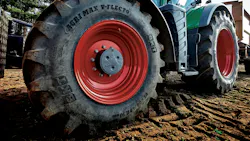
There is more to an ag wheel than diameter and width. Rim contour, bolt circle, center bore, offset and bead seat all matter. A tire may physically fit on a wheel, but that doesn’t mean it’s the right wheel or that a customer will get the performance they should out of the tire.
The two most common rim contours on larger ag equipment are W and DW. A third, TW (triple-well), is becoming more common in the aftermarket. The W is a single-well design and DW is a double-well. The well or drop gives you room to mount and demount the tire. As you're mounting the tire, the bead drops into the smaller diameter of the well and gives you enough room on the other side to get the bead over the flange. A DW gives you the additional well to aid in mounting and demounting, while TW takes that a step further with a triple-well profile. Where a DW rim is an approved rim for the tire, the corresponding TW profile may also be approved.
Using a different width can change the shape of the tire, how the bead seats and the amount of stress in the bead area. Mounting on the incorrect rim profile can also make the tire much harder to seat correctly. For example, mounting a high-load-index standard radial sprayer tire on a W rim can be difficult and increase the chance of bead damage when that tire is designed around a DW rim.
When you're dealing with tires carrying more load, running lower air pressures and putting more horsepower to the ground, the wheel is an important part of making the whole package work correctly.
Wheel measurements matter just as much, so it pays to understand the basics: 15-inch x 10-inch, 6-6-inch bolt circle, 4 5/8-inch center bore and1 1/8-inch offset.
The 15-inch x 10-inch gives you the wheel diameter and width. The 15 inches is measured at the bead seat, not across the outside of the flange. The 10 inches is the nominal width between the bead seats. The 6-6-inch bolt circle means we have six mounting holes on a six-inch bolt circle. The 4 5/8-inch center bore is the diameter of the center hole. The 1 1/8-inch offset tells us where the wheel sits in relation to the mounting surface.
Offset, inset and outset become especially important when building custom wheels. Getting the bolt pattern right doesn’t do your customer much good if you put the tire in the wrong place on the tractor. On a row-crop tractor, you may be trying to hit a specific row spacing. You need to know where that tire is going to sit once everything is mounted. You also need enough clearance from the tractor, axle, fenders and anything else around it. I’ve dealt with plenty of custom wheel applications where these measurements become just as important as the diameter and width of the wheel itself.
The bead seat itself is another part of the wheel that’s easy to overlook. Several differences in bead-seat design can affect how the tire mounts, seats and performs. One of those features is knurling. Look closely at the bead seat on many larger ag wheels, especially ones designed for drive applications, and you’ll see ridges stamped or formed into the bead seat. Knurling gives the tire bead something to grip, keeping the tire from slipping or indexing on the wheel. That grip matters more than ever with today’s horsepower and IF and VF tires running at lower pressures.
Flange height is another difference to watch. Some flotation tires are designed for a VA rim only, which uses a taller bead flange than a W or DW rim and will typically be multi-piece assemblies. That taller flange gives the bead the support it was designed around. Putting that tire on a shorter flange can add stress to the bead area and increase the chance of bead damage or failure. Always check the tire manufacturer’s rim contour guidelines.
Then there is bead-seat taper. Many traditional ag wheels use a five-degree bead seat, while we’ll also see 15-degree bead seats in flotation and other ag applications. The tire bead is designed around that angle, so we need to recognize the difference and match the tire size to the correct rim profile.
Any time the tire is off, look the wheel over. Look at the flanges, welds, center disc and bolt holes. On adjustable or multi-piece wheels, look at the hardware and mounting areas. With multi-piece wheels, know exactly which components you’re working with. Parts that look similar aren’t necessarily interchangeable.
Loader tractors are one application where I pay particular attention to the wheel and hardware. Between the load, torque and constant changes in direction, they can be hard on wheel assemblies. Cracking around the mounting areas and hardware that isn’t staying torqued are things worth looking for. We spend a lot of time making sure we’re putting the right tire on the tractor or implement. We should probably spend a little more time making sure we’re putting it on the right wheel.
Dave Paulk, manager, field technical services, BKT USA Inc.: There are many agricultural wheel sizes currently used in the U.S. market. The most common large agricultural wheel diameters are 38-inch, 42-inch, 46-inch, 50-inch and 54-inch.
DW20B × 38-inch is typically used with 650/65 R38 tires and commonly found on mid-size tractors and row-crop tractors. DW16L × 42-inch is typically used with 520/85 R42 tires and commonly fitted on large row-crop tractors and combines, especially in dual-wheel configurations. W12 × 46-inch is typically used with 380/90 R46 tires and commonly found on row-crop tractors and high-horsepower tractors. W13 × 50-inch is typically used with VF380/90 R50 tires and commonly fitted on self-propelled sprayers and large MFWD (mechanical front-wheel drive) tractors with dual or triple wheel configurations. DW11 × 54-inch is typically used with VF320/105 R54 tires and commonly found on four-wheel steering tractors and large self-propelled sprayers.
Let's look at rim contours W versus DW. The primary difference between W and DW rim contours is that W stands for Single Well and DW stands for Double Well. In general, DW rims facilitate easier tire mounting and demounting due to their double-well design. DW rims also typically feature a wider bead seat compared to standard W rim profiles, making them suitable for larger and wider tire sections.
W rims are generally used with narrow to medium section-width tires, while DW rims are commonly used with wider tires that require higher load-carrying capacity, such as VF and CFO (cyclic field operation) tires. As a result, DW rims are more commonly found on modern high-horsepower tractors, sprayers, combines and other agricultural equipment utilizing wide-section tires operating at lower inflation pressures. Popular sizes include:
-
W12X46 – 380/90R46
-
DW20BX38 – 650/65R38
-
DW16LX50 – VF480/95R50
-
DW11X54 – VF320/105R54 CFO
These are 5-degree, drop-center rim contours commonly used in agricultural implement applications. They are typically available in 14-inch, 15-inch and 16-inch rim diameters, which are among the most widely used sizes for implement tires. The 5-degree drop-center design facilitates easier tire mounting and demounting while providing reliable bead seating for implement service applications. Popular sizes include:
-
6LB X 16 – 7.50-16SL
-
8LB X16 – 10.00-16SL
-
8LB X 15 – 9.5L-15SL
There are two types of wheel offsets: positive offset and negative offset. The required offset depends on the machine configuration and application requirements.
Trevor Wilson, marketing specialist, Maxam Tire International: An agricultural wheel is defined by five core specifications: bolt circle, center bore, offset, rim contour and knurling. Large agricultural wheels fall into three main categories, each built around a different tire and application: large ag drive wheels, implement wheels and flotation wheels. Each category uses a distinct rim contour and bead seat design suited to how the tire on it needs to perform.
Large ag wheels are typically designated by their rim contour profiles — most commonly W (Wide Well), DW (Deep Well) or TW (Triple Well) — referring to the relief zone or well built into the rim bed. The well exists to make tire mounting and demounting possible without damaging the tire beads. During mounting, the tire bead is pushed into the well, which provides the necessary slack to walk the opposite side of the bead over the rim flange. Without that relief zone, a stiff radial or bias ag tire bead could not be worked onto the rim by hand or with standard shop tools.
Implement wheels are engineered for towed equipment like grain carts, planters, manure spreaders and tillage tools rather than the tractor itself. Implement wheel rim contours, often utilizing standard 5-degree, drop-center or specialized heavy-duty W/DW profiles, are built around the vertical load profile of towed equipment rather than managing the continuous rotational drive torque and traction demands of a tractor wheel.
Knurling is a textured, ribbed pattern machined or rolled into the bead seat area of the wheel rim where the tire bead sits. Its purpose is to increase mechanical friction between the tire bead and the wheel, preventing the tire from slipping or spinning on the rim under high drive torque.
Yokohama TWS: An agricultural wheel is a strongly constructed metal rim and disc assembly built for farm equipment. Proper positive offset ensures tires clear frame rails, steering components and suspension parts. Correct alignment reduces excessive bearing wear caused by improper wheel positioning.